
Introduction
Picture a shop floor scheduler building next week's production plan. Every job has a start time, every machine looks fully booked, and the spreadsheet says 90% utilization.
Then Monday hits: changeovers between jobs weren't accounted for, and the "perfect" schedule falls apart by 10 a.m.
Setup time is one of the most overlooked, capacity-draining variables in manufacturing. It's especially brutal in high-mix, low-volume shops where machines rarely run the same part twice in a row.
This article defines setup time, breaks down its types and phases, and walks through real manufacturing examples, explaining why it belongs at the center of any accurate production schedule.
Key Takeaways
- Non-productive prep work before a machine runs a new job counts as setup time, separate from actual output time
- High-mix shops lose significant capacity to changeovers, making setup a critical scheduling variable, not an afterthought
- Fixed or sequence-dependent, setup time drops significantly through methods like SMED, directly recovering usable capacity
- Ignoring setup in scheduling inflates perceived capacity, leading to delivery promises the floor can't keep
What Is Setup Time?
Setup time, sometimes called changeover time, is the time needed to prepare a machine or workstation for a new production operation before it can start running. It's the gap between finishing one job and producing the first acceptable piece of the next one.
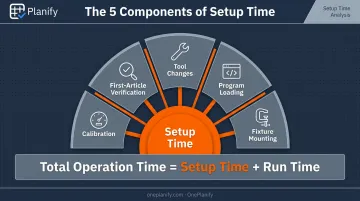
Setup typically includes:
- Tool changes – swapping cutting tools, dies, or molds for the new job
- Program loading – calling up or editing the CNC or PLC program
- Fixture mounting – installing and aligning the correct workholding
- Calibration – adjusting offsets, pressures, or speeds for the new part
- First-article verification – running and checking a trial part before full production begins
That last item matters more than people think. Modern Machine Shop defines machining setup time as the elapsed time from the last completed workpiece of the prior run to the first acceptable workpiece of the next run, which means setup isn't finished when the tool is bolted in.
It's finished when the part passes inspection.
Setup time is non-productive. The machine is occupied, the operator is busy, but nothing saleable is coming off it.
A 2020 case study of a small make-to-order metalworking operation recorded 221 changeovers in a single year, with a mean changeover time of roughly 12 hours on multi-spindle cam lathes. That's a lot of clock time spent preparing, not producing.
For job costing and scheduling purposes, total operation time captures both pieces:
Total operation time = setup time + run time
If you only track run time, your costing understates the true cost of small batches, and your schedule overstates how much capacity you actually have.
Types and Phases of Setup Time
Not all setups are created equal. Understanding the type of setup you're dealing with, and the phases inside it, is the difference between a schedule that holds and one that slips by lunchtime.
Fixed vs. Sequence-Dependent Setup Time
Fixed setup time stays the same no matter what job ran before it. A stamping press that requires a full die teardown and rebuild for every job is a good example. Whether the previous run was Part A or Part Z, the operator tears down the old die completely and starts fresh. The duration doesn't change based on sequence.
Sequence-dependent setup time varies based on what ran immediately before. A CNC turning center might need:
- Just a chuck-to-chuck change (a few minutes) when moving between two similar parts
- A full fixture swap (an hour or more) when the next job requires a completely different workholding setup
This distinction matters enormously for scheduling, because grouping jobs by similarity can shrink total changeover time without touching run time at all.
The Four Phases of a Machine Setup
Most setups move through four distinct phases:
- Dismantling and restoring – removing the prior job's tooling, fixtures, and programs, and returning the machine to a neutral state
- Mounting and adjusting – installing new tooling, fixtures, or dies and setting offsets or pressures
- Trial run – producing a test or first-article part to confirm the setup is correct
- Final adjustments – fine-tuning based on trial results before releasing the machine to full production
Skipping any of these phases (especially the trial run) is how scrap and rework sneak into a schedule that looked clean on paper.
SMED and Setup Time Reduction
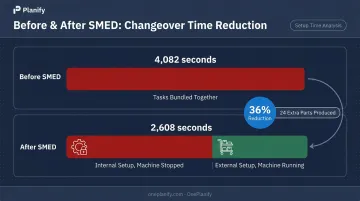
SMED, or Single-Minute Exchange of Dies, is a lean methodology built around one core idea: split setup work into what must happen while the machine is stopped and what can happen while it's still running.
- Internal setup – work that requires the machine to be stopped, such as installing a new die
- External setup – work that can happen beforehand, such as staging the next die, tools, or program
The Lean Enterprise Institute describes SMED's goal as achieving a single-digit-minute changeover — not literally one minute, but under ten. The method works by identifying internal tasks, converting as many as possible to external tasks, then simplifying what's left.
A 2023 automotive parts assembly study applied SMED to a welding-robot changeover and cut setup time from 4,082 seconds to 2,608 seconds, a 36% reduction. That saved roughly 24 minutes per changeover, which the researchers noted was enough to produce 24 additional parts without changing takt time at all.
Setup Time vs. Related Manufacturing Terms
Shop floors throw around "setup," "run," "cycle," and "hold" time pretty loosely. That's fine in casual conversation, but it causes real problems when these terms feed into a schedule.
Here's how these terms actually differ:
| Term | Definition | How It Differs from Setup Time |
|---|---|---|
| Setup Time | Time to prepare a machine or process before production begins | Paid once per batch, not per unit |
| Hold Time | Required waiting period, like curing, cooling, or warm-up | Waiting, not preparation work |
| Run Time | Per-unit production time once setup is complete | Repeats with every unit produced |
| Cycle Time | Total time to produce one unit, including run time plus any repeating waits | Broader measure that includes run time |
Both setup and hold time can apply to the same operation. A machine might need a setup to load the next job, then a hold period (like a heat-treat cool-down) before the part moves to the next station.
In pharmaceutical continuous manufacturing, ICH Q13 guidance defines hold time as temporary storage during an interruption in production.
This is exactly why standardized routing data matters. When "setup" on one job report means something different than "setup" on another, your scheduling accuracy falls apart before you've even started.
Setup Time Examples in Manufacturing
Numbers make this real. Here's how setup time plays out across a few common manufacturing environments.
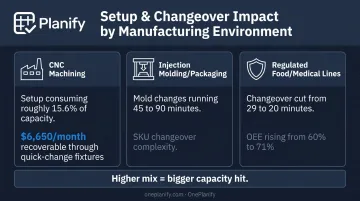
CNC Machining: A Monthly Capacity Snapshot
Say a job shop runs four CNC machines, 22 days a month, 16 hours a day. That's 1,408 available machine-hours for the month.
- Setup hours logged: 220
- Run hours logged: 1,188
- Setup as a share of total capacity: ~15.6%
Now suppose the shop invests in quick-change fixtures and better tool staging, cutting setup hours to 150 for the same workload. That frees up 70 hours of capacity that shifts from setup to run time. At a $95/hour billing rate, that's roughly $6,650 in recovered monthly capacity, without buying a single new machine.
Injection Molding and Packaging Changeovers
Mold changes involve planning, the physical "steel-to-steel" swap, and startup adjustment before the resin flows consistently. A typical mold change on a mid-size press runs 45 to 90 minutes, depending on tool complexity and purge requirements.
Packaging lines face a similar challenge switching between SKUs: new labels, new fill settings, new packaging materials, all before the first good unit rolls off the line.
Regulated Environments: Cleaning and Validation
Food and medical device lines add another layer entirely. A 2022 case study of a ready-meal factory running 70+ products across 12 lines used SMED principles to cut average changeover from about 29 minutes to 20 minutes, with some lines dropping under 9 minutes using line-hopping techniques.
Overall equipment effectiveness rose from 60% to 71% as a result. Allergen and sanitation controls, though, remained a hard floor beneath which changeover time couldn't drop further.
The common thread across all three examples: the more frequent and complex the changeovers, the bigger the dent in usable capacity. A shop running long batches of similar parts barely notices setup. A high-mix shop running 15 jobs a week feels it every single day.
Why Setup Time Matters for Production Scheduling
Here's the uncomfortable truth: a schedule that ignores or underestimates setup time is just a wish list dressed up as a plan.
When planners build schedules around theoretical run rates without factoring in changeovers, two things happen. Delivery dates get promised based on capacity that doesn't exist, and the shop's perceived utilization looks far better on paper than it performs on the floor.
Setup-aware sequencing fixes this by grouping similar jobs to run consecutively on the same machine or tooling before a changeover happens. Instead of bouncing between unrelated parts all week, jobs get clustered by tooling family, material, or fixture requirement. Less re-tooling. More spindle time.
This is the problem OnePlanify was built to solve. The platform models setup, run, teardown, and move time as separate components for every operation, then applies sequence-dependent setup matrices that recognize Job A to Job B might cost 45 minutes of changeover while Job A to Job C only costs 15.
From there, the scheduling logic runs automatically:
- Groups compatible jobs to minimize total re-tooling time
- Factors in shift calendars, dependencies, and disruptions in the same pass
- Replans the entire board in seconds when a machine goes down or a rush order lands, preserving setup constraints instead of dropping them like a manual spreadsheet rebuild often does
The result is a schedule reflecting real available capacity, not the theoretical version that looks clean until the first changeover eats into it.
Practical levers for reducing setup time on your own floor:
- Standardized setup sheets so every operator preps the same way, every time
- Pre-staged tooling ready before the machine actually stops
- Dedicated fixtures for high-runner parts to skip full teardown cycles
- Setup-aware job sequencing built directly into your scheduling system
Frequently Asked Questions
What is setup time in manufacturing?
Setup time is the non-productive time needed to prepare a machine or workstation for a new job before production can begin. It covers tooling changes, program loading, fixture mounting, and first-article verification.
What are setup and hold times?
Setup time is preparation work done before a job runs. Hold time, by contrast, is a required waiting period such as cooling or curing that occurs after setup or during processing. Both can apply within the same operation.
How is setup time calculated?
Manufacturers typically measure setup time as the elapsed time from the end of the previous job's run to the start of the first acceptable part on the new job. Shops track this using timestamps, MES data, or manual logs.
What is the difference between setup time and cycle time?
Cycle time is the full time required to produce one unit, including all repeating steps. Setup time is a one-time preparation cost that's spread across an entire batch, not repeated per unit.
How can manufacturers reduce setup time?
SMED principles help by separating tasks that require a stopped machine from those that can happen beforehand. Standardized procedures, pre-staged tooling, and setup-aware job sequencing all shrink changeover duration further.
Is setup time included in lead time?
Yes. Setup time generally counts as part of production lead time, factored into total operation time on the shop floor alongside run time and any required hold periods.