
This confusion isn't just semantic. Manufacturing and construction companies routinely struggle to fill this role because job descriptions mash together two distinct skill sets, leaving qualified candidates unsure what they're actually applying for. Neither the Project Management Institute (PMI) nor the Association for Project Management (APM) formally recognizes "scheduler" as a standalone role, which is exactly why hybrid titles like this one exist in practice.
This guide breaks down what a planner scheduler actually does day to day, the skills and certifications employers look for, realistic salary expectations, and a concrete path to break into the field.
Key Takeaways
- Planner schedulers combine strategic planning with precise, tactical scheduling and monitoring
- Manufacturing and construction employers pay premiums for CPM and scheduling software expertise
- Average US pay sits around $96,000-$97,000, varying by industry and experience level
- PMI-SP certifies scheduling expertise; PMP and PRINCE2 cover broader project leadership
- Common career paths include senior planner, PMO lead, and operations manager roles
What Is a Planner Scheduler?
A planner scheduler is a hybrid role. It fuses project planning (defining what needs to happen, who does it, and what resources it requires) with detailed scheduling, which pins down exact timing, sequencing, and day-to-day tracking.
Large organizations with mature Project Management Offices (PMOs) sometimes split these into two dedicated positions: a planner and a scheduler. But smaller teams, and industries like manufacturing where headcount is tighter, typically fold both functions into one person. That person plans the work and builds the schedule that makes it real.
Planner vs. Scheduler: What's the Real Difference?
Think of it like an architect versus a construction crew. The architect designs the blueprint: the vision, the structure, the sequence of major phases. The crew takes that blueprint and figures out exactly which trade shows up on which day, in what order, with what materials on hand.
That's the core planner-scheduler split:
- Planners work the strategic front end: scope, resource needs, sequencing logic, and risk assessment before execution starts
- Schedulers translate that plan into a tactical, detailed timeline, assigning dates and resources, then monitoring execution daily
- In smaller organizations, one person often handles both roles, moving fluidly between planning and scheduling tasks
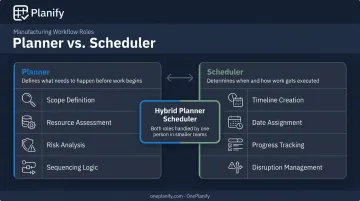
Part of the confusion around this title comes from the fact that no governing body has ever formally defined "scheduler" as its own occupation. APM's competence framework describes integrated planning and time-based schedule management as distinct skill areas, but it stops short of naming a standalone scheduler job. That gap is exactly why combined titles like "planner scheduler" emerged organically across industries.
What Does a Planner Scheduler Do? Key Responsibilities
The day-to-day work splits between upfront planning and ongoing schedule management. A typical week involves:
- Gathering requirements from managers, production leads, or stakeholders to understand project or production objectives, constraints, and priorities
- Building comprehensive plans that define scope, deliverables, task breakdowns, and realistic timelines before work begins
- Constructing detailed schedules using Gantt charts, critical path method (CPM) analysis, or dedicated scheduling software
- Monitoring progress continuously, flagging delays, bottlenecks, or resource conflicts before they snowball into missed deadlines
- Managing real-time disruptions (machine changeovers, shift changes, material delays, dependency conflicts) and communicating impact through clear status updates
The specifics shift depending on the setting. A manufacturing planner scheduler spends much of the week reacting to labor shortages, material delays, and machine downtime, revising the production schedule to keep material flowing.
A construction planner scheduler, by contrast, focuses more on dependency chains, deadline compliance, and recovering from weather delays or site emergencies.
Both roles share a common thread: the schedule is never static. It's a living document, stress-tested against reality every single shift.
Skills & Qualifications a Planner Scheduler Needs
Employers look for a mix of technical fluency and interpersonal skill. Neither alone gets the job done.
Technical skills:
- Proficiency in scheduling methodologies like Critical Path Method (CPM) and Program Evaluation and Review Technique (PERT)
- Resource allocation and leveling
- Working knowledge of scheduling software, plus ERP or Manufacturing Execution Systems (MES) where relevant
Soft skills:
- Communication strong enough to translate complex schedule data for non-technical stakeholders
- Attention to detail—a missed dependency can cascade into weeks of delay
- Calm problem-solving under tight, shifting deadlines
Educational background: A degree in business, engineering, supply chain, or project management is common groundwork. Many candidates pair that with a certification such as PMP, PRINCE2, or PMI-SP to formalize their expertise.
These certifications aren't interchangeable. PMI-SP is the only credential built specifically to validate schedule creation, maintenance, and analysis. PMP and PRINCE2 cover broader project leadership and methodology, but neither replaces that scheduling-specific depth.
How to Become a Planner Scheduler: A Step-by-Step Path
There isn't one standardized entry route into this field, but a pattern shows up consistently across job postings and career data.
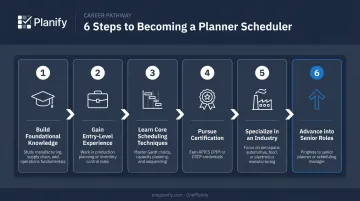
Build foundational knowledge. Pursue a degree or coursework in project management, engineering, business, or supply chain and operations. This gives you the vocabulary and frameworks employers expect.
Gain entry-level experience. Roles like production coordinator, project administrator, or scheduling assistant expose you to real workflows—how work orders move, how delays get communicated, how priorities shift.
Learn core scheduling techniques. Get hands-on with Gantt charts, the critical path method, and resource leveling. Formal training courses help, but nothing beats building an actual schedule and watching it break under real disruptions.
Pursue a recognized certification. PMP, PRINCE2, or PMI-SP validate broad project competence. If you're heading into manufacturing or supply chain contexts specifically, APICS/ASCM's CPIM or CSCP credentials carry more direct relevance.
Specialize in an industry. Construction, manufacturing, IT, and healthcare each demand distinct scheduling complexity and tools. Picking a lane early helps you build depth instead of staying generalist forever.
Advance into senior roles. Taking on larger, cross-functional projects and mentoring junior staff opens doors to senior planner/scheduler, PMO lead, or scheduling manager positions.
Labor data reveals two common entry routes:
| Entry Path | Typical For |
|---|---|
| High school diploma + on-the-job training | Production-planning clerk roles |
| Bachelor's degree | Project management specialist positions |
Which route applies to you depends on whether you're aiming at a manufacturing floor or a corporate project-controls office.
Planner Scheduler Salary & Career Outlook
Pay for this role varies more by exact title, industry, and location than almost any other factor. Here's a snapshot of current US data:
| Title (2025 data) | Average Salary | 25th-75th Percentile |
|---|---|---|
| Planner Scheduler | $96,282 | $77,314 - $120,915 |
| Project Scheduler | $97,335 | $77,429 - $123,327 |
| Production Planner and Scheduler | $98,309 | Varies by employer |
The table above reflects Glassdoor's 2025 compensation data, though the sample size is small enough that these figures are directional rather than exact.
Industries with higher scheduling complexity typically pay more. Manufacturing and construction employers routinely pay a premium for planner schedulers with proven technical chops, particularly those comfortable navigating shop floor disruptions or multi-trade dependency chains.
Geography matters too. Metro areas with dense manufacturing or engineering activity tend to command noticeably higher pay than smaller markets.
A typical career trajectory looks like this:
- Entry-level scheduler → learning the tools, building schedules under supervision
- Planner scheduler → owning full plan-to-schedule ownership for a project or production line
- Senior planner/scheduler → handling larger, cross-functional scope, mentoring newer staff
- PMO or operations manager → owning scheduling strategy across multiple projects or an entire facility
This isn't a guaranteed escalator. Progression branches based on whether you lean toward project controls, operations management, or specialized planning functions.
Tools & Technology That Help Planner Schedulers Succeed
Modern planner schedulers can't run on spreadsheets alone once complexity crosses a certain threshold. Gantt charts, CPM/PERT tools, and ERP systems all help manage the moving pieces, but manufacturing shop floors add layers most generic project management tools were never designed to solve.
Consider what a spreadsheet actually can't do: it can't enforce that Operation 20 waits for Operation 10 to finish. It can't account for the fact that switching from Job A to Job B takes 45 minutes of changeover time, while Job A to Job C only takes 15.
That gap is why a schedule that looks 85% utilized on paper often runs closer to 60% in reality. Setup and changeover time simply vanish from the math.
This is the exact gap OnePlanify's Planify platform was built to close. Rather than replacing your ERP, it sits alongside it as a dedicated scheduling layer that handles:
- Sequence-dependent setup modeling: recognizes that changeover time depends on which job ran before it, not just a flat average
- Shift-aware scheduling: builds shift calendars per work center, so jobs never land in a window that doesn't exist for that machine
- Dependency enforcement: treats multi-operation routings (like mill → weld → finish) as locked sequences that survive even a full disruption replan
- Rush-order replanning: resequences the entire production board in seconds, with a "Run on Pretend" mode that previews impact before you commit
The design goal is simple: keep the ease of a spreadsheet while adding the finite scheduling logic that spreadsheets structurally can't provide. Planners get a tool that reflects who's actually on the floor and when, without needing a six-month IT project to get there.
Frequently Asked Questions
What does a planning scheduler do?
A planning scheduler creates project or production plans, builds detailed schedules, monitors progress against them, and adjusts timelines in response to real-time changes or disruptions. The role blends upfront strategy with ongoing tactical execution.
How much does a planning scheduler get paid?
US averages currently sit around $96,000 to $97,000, according to 2025 Glassdoor data. Pay varies by industry, experience level, and geographic location.
What is the difference between a planner and a scheduler?
A planner focuses on strategic groundwork—scope, resources, and sequencing—before execution begins. A scheduler handles tactical execution, assigning specific dates, tracking daily progress, and managing disruptions in real time.
Is a planner scheduler a good career choice?
Yes, particularly in construction, manufacturing, and IT, where demand stays steady. Clear advancement paths exist toward PMO leadership or operations management roles for those who build cross-functional experience.
What certifications help the most for a planner scheduler role?
PMI-SP validates schedule-specific expertise, while PMP and PRINCE2 cover broader project leadership. In manufacturing or supply chain settings, APICS/ASCM's CPIM or CSCP credentials carry additional relevance.
Which industries hire the most planner schedulers?
Construction, manufacturing, IT, engineering, and healthcare organizations with established PMOs are the largest employers. Manufacturing and construction in particular tend to pay a premium for proven scheduling expertise.