Together, these two disciplines determine what to produce, how much, and when, then translate that plan into a detailed shop-floor timeline your team can actually execute. Many manufacturers still handle this with spreadsheets that break down the moment reality gets complicated.
This guide covers what production planning and scheduling actually are, why they matter, how the process works step-by-step, the types and methods manufacturers use, and the factors that determine whether execution succeeds or falls apart.
Key Takeaways
- Production planning sets strategic direction (what and how much to produce); scheduling drives tactical execution on the floor
- A five-step process (forecasting, capacity planning, material planning, scheduling, and monitoring) forms the backbone of manufacturing operations
- Job, batch, flow, mass, and process production each pair with different scheduling methods depending on volume and variety
- Poor planning creates bottlenecks and missed deadlines; structured processes cut costs and improve on-time delivery
- Manual spreadsheets typically break down once setups, shift changes, and dependencies enter the picture
What Is Production Planning and Scheduling?
Production planning is the strategic process of deciding what products to make, in what quantities, and by when. It's based on demand forecasts and the resources you actually have available: labor, equipment, and facility capacity.
Production scheduling is the tactical process that follows. It sequences specific jobs, assigns machines and labor, and sets exact timelines so the production plan gets executed on the floor without conflicts.
The two exist to achieve different outcomes. Planning balances supply and demand at a macro level, answering "can we realistically make this much of these products?" Scheduling ensures smooth, conflict-free execution day to day, answering "what runs on which machine, in what order, starting when?"
Production Planning vs. Production Scheduling: What's the Difference?
The clearest way to separate the two is by timeframe, flexibility, and focus:
- Timeframe: Planning operates at a medium-term, strategic level; scheduling is short-term, often covering days or weeks
- Flexibility: Planning is relatively fixed once set; scheduling adapts daily as jobs, disruptions, and priorities shift
- Focus: Planning centers on resource allocation across product families; scheduling centers on sequencing individual tasks and operations
- Output: Planning produces an aggregate plan; scheduling produces an executable, day-by-day shop-floor timeline
Planning sets the direction. Scheduling operationalizes it. Neither works well without the other. A solid plan with a broken schedule still misses deadlines, and a tight schedule built on a bad plan just executes the wrong priorities efficiently.
Why Production Planning and Scheduling Matter in Manufacturing
Manufacturing complexity keeps climbing. More SKUs, tighter lead times, and rising input costs make structured planning a competitive necessity rather than a nice-to-have.
In its Q3 2025 survey of 241 manufacturers, the National Association of Manufacturers found respondents expected input costs to rise an average 5.4% over the following 12 months. That kind of cost pressure leaves little room for wasted capacity or idle labor.
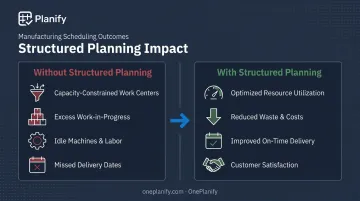
Without proper planning and scheduling, the failure modes are predictable:
- Bottlenecks at capacity-constrained work centers
- Excess work-in-progress piling up between stations
- Idle machines and labor waiting on upstream operations
- Missed delivery dates that erode customer trust
Downtime compounds the damage. Siemens' 2024 downtime study estimated costs can reach $150,000 per hour for SMB manufacturers, and far more for large plants. A schedule that can't absorb disruption turns a single breakdown into a cascading delay.
Done well, structured planning and scheduling deliver:
- Optimized resource utilization across machines and labor
- Reduced waste and lower production costs
- Improved on-time delivery rates
- Increased customer satisfaction and repeat business
None of this happens in a vacuum. Real schedules have to account for setups, shift changes, task dependencies, and disruptions, not just a clean theoretical timeline. Disciplined planning isn't mandated by regulation, but it's closely tied to lean principles and treated as standard practice on well-run shop floors. Adoption comes down to operational maturity, not compliance.
The Production Planning and Scheduling Process: Step-by-Step
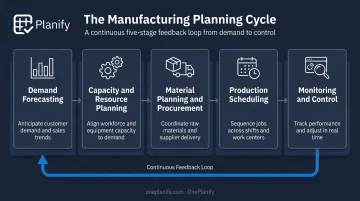
Planning and scheduling function as a connected loop, not separate exercises. Demand forecasts feed capacity and material planning, which feed the schedule, which gets tracked and fed back into the next planning cycle.
Step 1: Demand Forecasting
Forecasting uses historical sales data, market trends, and customer forecasts to estimate future demand. Get this wrong and you either overproduce, tying up cash in inventory, or underproduce, missing orders you could have filled.
Step 2: Capacity and Resource Planning
Next, available labor, equipment, and facility capacity get assessed against that forecasted demand. This step confirms feasibility before commitments get made to customers or suppliers.
Step 3: Material Planning and Procurement
Required raw materials and components get identified and ordered early enough to avoid delays. Supplier lead times matter here; a material that arrives a week late stalls everything downstream of it.
Step 4: Production Scheduling
This is where the detailed sequence and timeline for orders gets built, factoring in setups, shift patterns, task dependencies, and machine or labor availability. It's also typically where manual spreadsheets break down under real-world complexity.
A spreadsheet can list jobs, but it can't calculate that Job A to Job B needs a 45-minute changeover while Job A to Job C only needs 15. It also can't enforce that Op 20 waits until Op 10 finishes.
This is exactly why purpose-built finite scheduling tools exist. OnePlanify keeps scheduling as simple as a spreadsheet to use, while handling the parts spreadsheets can't:
- Tracks sequence-dependent setup and changeover times between specific jobs
- Applies real shift calendars per work center, including overtime rules and holidays
- Manages multi-operation routing with predecessor locks (Op 10 → Op 20 → Op 30)
- Resequences the full board in seconds when a machine goes down or a rush order lands
Step 5: Production Monitoring and Control
Real-time tracking against the schedule lets managers catch deviations early, before a small delay becomes a full bottleneck. This step feeds performance data back into the next forecasting and planning cycle, closing the loop.
Types of Production Planning and Scheduling
Different products and volumes call for different planning types. The main categories are:
- Job production: Low volume, high customization, flexible routings, common in machine shops
- Batch production: Groups of similar items moving stage by stage; think bakeries or pharmaceutical ingredients
- Flow production: High volume with a fixed operation sequence, such as automobile assembly
- Mass production: High volume, low variety, standardized and interchangeable output
- Process production: Continuous transformation of materials, typical in chemical manufacturing
Scheduling methods pair with these production types:
- Forward scheduling: Starts from today's date and calculates the earliest feasible completion
- Backward scheduling: Starts from the due date and works backward to the latest possible start
- Master production scheduling (MPS): A time-phased statement of which end items get produced, in what quantities, and when
- Finite capacity scheduling: Assigns work within actual machine and labor limits
- Infinite capacity scheduling: Loads work without limits, useful for spotting overloads before finalizing a schedule
- Just-in-time (JIT) scheduling: Produces only what's needed, when it's needed, in the amount needed
There's no one-size-fits-all combination here. A job shop running high-mix, low-volume work needs different tools than a plant running continuous flow.
Platforms like OnePlanify focus specifically on finite capacity scheduling, since it accounts for the actual machine and labor limits shops operate under. The right pairing still depends on product complexity, order variability, and volume.
Key Factors, Common Mistakes, and Best Practices
A handful of factors consistently determine whether planning and scheduling succeed:
- Forecast accuracy
- Resource and capacity availability
- Supplier lead times
- Product complexity
- The plan's flexibility to absorb disruptions
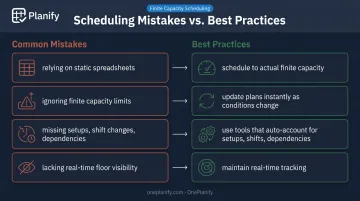
Common mistakes show up again and again on shop floors:
- Relying on static spreadsheets for scheduling complex, multi-operation jobs
- Ignoring finite capacity constraints and scheduling past what resources can handle
- Failing to account for setups, shift changes, or task dependencies
- Lacking real-time visibility into what's actually happening on the floor
NIST's manufacturing extension program documented what fixing these issues looks like in practice. At Stainless Works, updating routing data and forward-scheduling a welding bottleneck cut lead time from 12-14 weeks down to 5 weeks, alongside measurable cost savings and retained sales.
Results like these come from applying a few practices consistently on the shop floor:
- Build schedules around actual finite capacity, not optimistic assumptions
- Update the plan the moment conditions change
- Use tools that automatically account for setups, shift changes, and dependencies
Legacy APS systems can handle this, but often at six-figure cost and with year-long implementations. OnePlanify delivers the same finite-scheduling rigor without that overhead, built specifically for shop floor complexity.
Frequently Asked Questions
What are the 5 steps of manufacturing production planning?
The five core steps are demand forecasting, capacity and resource planning, material planning and procurement, production scheduling, and monitoring and control. Together they form a closed loop that feeds back into future planning cycles.
What is production planning in manufacturing?
Production planning is the strategic process of deciding what to produce, how much, and when, based on demand forecasts and available resources. It sets the direction that scheduling later executes on the floor.
What are the types of manufacturing production planning?
The main types are job, batch, flow, mass, and process production. Each suits a different combination of volume and customization, from highly variable job shop work to continuous process manufacturing.
What is the difference between production planning and production scheduling?
Planning is strategic and longer-term, focused on resource allocation and feasibility. Scheduling is tactical and short-term, focused on sequencing specific jobs and executing the plan day to day.
What is the goal of production planning and scheduling?
The shared goal is meeting customer demand efficiently while optimizing resource use and minimizing costs. Planning and scheduling work together to hit delivery dates without wasting capacity.
What software is used for production scheduling?
Manufacturers use everything from basic spreadsheets to finite capacity scheduling software. OnePlanify, for example, handles multi-operation routing, setup changeovers, and disruption replanning directly on the shop floor.