
Introduction
It's 6:15 AM on the shop floor. Three CNC machines are running, two operators just clocked in, and the scheduling board says everything's on track. By 9 AM, one machine goes down, a rush order lands, and the "plan" from an hour ago is already fiction.
This happens every shift, in every plant. Resources get allocated daily (machines, operators, time, materials), but few plants achieve true efficiency. The result: idle machines waiting on setups, rushed overtime to hit a due date, and missed delivery windows nobody saw coming.
This article breaks down what efficient resource allocation actually means, along with the principles and metrics that define it. We'll also show how modern scheduling technology turns that theory into something you can execute on the floor today.
Key Takeaways
- Efficient resource allocation matches people, machines, time, and materials to maximize value, not just fill gaps
- It relies on three types of efficiency: technical, allocative, and dynamic
- Poor allocation causes downtime, missed deadlines, and margin erosion; efficient allocation boosts throughput and delivery
- Finite scheduling tools that account for setups, shift changes, and disruptions turn theory into a daily plan
What Is Efficient Resource Allocation?
Resource allocation is simple to define: it's the process of distributing available resources (labor, machines, time, materials, budget) to achieve a desired outcome. Every plant does this, whether through a formal system or a planner's gut instinct.
Efficient resource allocation is different. It means achieving the greatest possible output or value from those resources with minimal waste. Not "assigned." Optimized.
The Three Types of Efficiency Behind the Concept
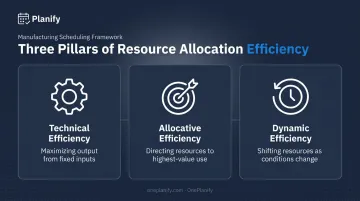
Economists break this down into three distinct categories, and each one applies directly to a shop floor:
- Technical efficiency: maximizing output from a fixed set of inputs, or hitting the target output with the fewest inputs possible, meaning no wasted idle time, no unnecessary scrap, no excess labor hours.
- Allocative efficiency: directing resources to their highest-value use, assigning jobs to the machines, tooling, and operators that best meet cost, due-date, and margin goals, not just whoever's free.
- Dynamic efficiency: shifting resources quickly as conditions change, so a schedule that can't adapt when a machine goes down isn't truly efficient, no matter how good it looked on paper.
Example: Picture a job shop with four CNC machines and six open work orders. Efficient allocation means no machine sits idle while orders wait, and no order gets rushed into overtime because a lower-priority job hogged capacity first. That's allocative and technical efficiency working together.
Here's the distinction that matters most: resource allocation happens regardless, since someone always decides who runs what, when. Efficient resource allocation is the optimized outcome organizations should be aiming for.
In manufacturing specifically, that optimization has to account for constraints that don't exist in an office setting: finite machine capacity, changeover time between jobs, shift patterns, and job dependencies. A law firm allocating attorney hours doesn't have to worry about setup time between clients. A machine shop does.
Why Efficient Resource Allocation Matters in Manufacturing
Late deliveries get blamed on "not enough capacity." More often, the real problem is misallocated capacity: resources sitting in the wrong place at the wrong time.
The Cost of Getting It Wrong
Downtime is the clearest evidence. According to NIST's 2024 Annual Report on the U.S. Manufacturing Economy, downtime equals 8.3% of planned production time and costs discrete manufacturers $245 billion annually. Scheduling can't eliminate every breakdown, but it can prevent the idle time and overtime scrambling that compound the damage.
Efficient allocation attacks that cost from three angles:
- Reduced overtime: jobs get sequenced so they don't pile up against the due date
- Lower work-in-progress: materials and machine time move together instead of waiting on each other
- Less idle machine time: capacity gets filled with the next available job, not left open
Throughput and Workforce Impact
Matching the right skilled operator to the right machine at the right time directly drives throughput. A qualified welder sitting idle while an unqualified one struggles through a job points to an allocation failure, not a labor shortage.
Workforce balance matters just as much. The 2024 Deloitte and Manufacturing Institute Talent Study found that 47% of manufacturers name flexible shift arrangements — including shift swapping and split shifts — as their most impactful retention strategy. Balanced workload allocation also functions as a retention strategy, not just an efficiency one.
Beyond the day-to-day, efficient allocation supports bigger goals: capacity expansion and new product launches, all while protecting margins. It's the difference between a plant that constantly fights fires and one that scales on purpose.
Principles and Metrics for Efficient Resource Allocation
Core Principles to Apply
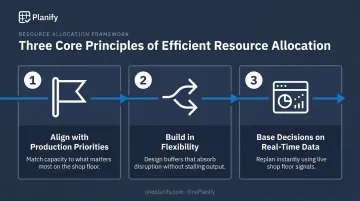
Three principles separate plants that allocate efficiently from ones that just "assign work":
- Align with production priorities: allocate available capacity to the highest-priority or highest-margin orders first, not whichever job is loudest that day
- Build in flexibility (dynamic efficiency): plan for the ability to reallocate quickly when a machine goes down or a rush order arrives
- Base decisions on real-time data: use actual machine status, job priority, and current capacity instead of a static plan built last week
How to Measure Resource Allocation Efficiency
You can't improve what you don't measure. A handful of metrics tell the real story:
Quantitative metrics:
| Metric | What It Tells You |
|---|---|
| Machine/resource utilization rate | How much available capacity is actually being used |
| On-time delivery rate | Percentage of orders shipped by the promised date |
| Cost per unit | Direct and indirect cost per finished item |
| Schedule adherence | How closely actual production tracks the plan |
Qualitative metrics matter too: employee satisfaction with workload distribution and customer feedback on delivery reliability both signal whether allocation is working in practice, not just on paper.
Note: there's no universal "good" number for utilization or on-time delivery. A benchmark from a high-mix job shop doesn't translate cleanly to a single-product production line: compare against your own historical performance and similar operations, not an industry-wide magic number.
Common Challenges to Efficient Resource Allocation on the Shop Floor
Even plants that understand these principles struggle to execute them. Three challenges show up again and again.
Production complexity overwhelms manual planning. Setups, shift changes, and job dependencies make spreadsheet-based scheduling slow to update and easy to get wrong. Add a rush order to a spreadsheet at 2 PM, and something downstream almost always gets missed.
Disruptions invalidate static schedules instantly. A machine breakdown, a material shortage, a rush order — any one of these can turn a "perfect" schedule into a fantasy the moment it's built. Static plans assume ideal conditions that rarely hold for a full shift, let alone a full week.
Visibility gaps hide the truth about capacity. When data lives in separate ERP systems, MES platforms, and paper logs, planners can't see real-time capacity before making allocation calls. They're often planning against yesterday's information.
The pattern behind all three: these plants rarely lack resources. They lack usable, real-time information about the resources already on hand.
How Technology Enables Efficient Resource Allocation
Spreadsheets and basic ERP scheduling modules share the same flaw: they assume unlimited capacity. A job gets a date, but nothing checks whether the machine, operator, and tooling are actually free at that moment.
Finite scheduling works differently. It models actual capacity constraints, including the setups, shift patterns, dependencies, and disruptions that define a real shop floor, and produces a schedule that's genuinely executable, not just theoretically sound.
Gartner's Market Guide for Detailed Manufacturing Scheduling places this kind of finite-resource modeling at the center of executable production scheduling, distinct from the infinite-capacity assumptions built into most planning tools.
What This Looks Like in Practice
This is the gap OnePlanify's Planify platform is built to close. Rather than assuming your floor runs 24/7 with unlimited tooling, it models the constraints that actually exist:
- Sequence-dependent setup times between specific job pairings, so changeover time is calculated, not guessed
- Shift calendars per work center, including 1st, 2nd, and 3rd shifts, overtime rules, and holiday exceptions
- Predecessor locks across multi-operation routings, so Op 20 never starts before Op 10 finishes
- Full-board replanning in seconds when a machine goes down or a rush order lands
That last point matters most. A breakdown doesn't require hours of manual rework. Planners can model the disruption first in a "Pretend Mode," see exactly which orders will slip and by how much, and commit only once they've picked the least damaging response.
The broader industry is moving this direction anyway. Deloitte's 2025 Smart Manufacturing survey reports employee productivity gains of 7% to 20% and 10% to 15% in unlocked capacity among large manufacturers adopting smart-scheduling technology.
The catch: that data comes from companies with $500 million-plus in revenue. OnePlanify exists to bring that same level of sophistication to smaller and mid-sized manufacturers, without the six-figure consulting engagement or the year-long rollout.
Frequently Asked Questions
What is resource allocation efficiency?
It's how well available resources (labor, machines, time, and materials) are used to maximize output and value while minimizing waste. It combines technical, allocative, and dynamic efficiency into one measurable outcome.
What is the most efficient way to allocate resources?
Combine data-driven prioritization with the flexibility to reallocate as conditions change. In manufacturing, that typically means finite scheduling software that accounts for real shop floor constraints like setups and shift patterns.
What are the three types of efficiency in resource allocation?
The three types work together:
- Technical efficiency: maximizes output from a given set of inputs
- Allocative efficiency: directs resources to their highest-value use
- Dynamic efficiency: lets resources shift quickly as conditions change over time
How is resource allocation different in manufacturing compared to other industries?
Manufacturing allocation must account for finite machine capacity, setup and changeover time, and shift-based labor availability. Office and service environments don't face these physical constraints.
What tools help manufacturers achieve efficient resource allocation?
Finite scheduling software like OnePlanify models real capacity constraints (shift calendars, setup times, and job dependencies) and automatically adjusts allocation when disruptions occur, rather than assuming unlimited resources.
How often should resource allocation be reviewed on the shop floor?
Treat it as a continuous, real-time process rather than a weekly plan. Disruptions like breakdowns and rush orders happen too often for a static schedule to stay accurate for long.