Introduction
Walk onto any manufacturing floor and you'll see it: materials moving in, machines running, people rotating through shifts, suppliers promising deliveries that may or may not arrive on time.
Many shops struggle to keep these pieces synchronized. A single misstep can cascade into blown delivery dates:
- Missed handoff between shifts
- Late shipment from a supplier
- Machine down for repair
- Scheduler working off outdated numbers
A Manufacturing Planning and Control (MPC) system is the framework that ties these moving parts together. It spans everything from long-range capacity decisions to what happens on the shop floor this afternoon.
This article breaks down what an MPC system actually is and unpacks its core components, including the often-confused MPS vs. MRP distinction. It also walks through how the system functions day-to-day and explains where finite scheduling fits into the bigger picture.
Key Takeaways
- MPC systems coordinate everything from long-range planning to daily dispatch, but don't make decisions on their own
- MPS defines what to build; MRP calculates the materials needed to build it
- Three planning horizons (long, intermediate, and short-term) each handles a distinct layer of manufacturing decisions
- Plans that ignore real shop floor constraints often fail regardless of how sound they look on paper
- Finite scheduling closes the gap between planned capacity and actual, executable schedules
What Is a Manufacturing Planning and Control System?
At its simplest, a Manufacturing Planning and Control system is a prioritizing method for allocating available resources, materials, labor, machines, to best satisfy customer requirements.
Rather than a single tool, it's an integrated set of processes covering the entire production lifecycle: sales and operations planning, master scheduling, material requirements, capacity planning, and real-time shop floor control.
Here's the part that trips up a lot of teams: an MPC system provides information for managers to make decisions—it doesn't make those decisions or run operations itself. The system tells you what's needed and when; people still have to act on it.
That coordination role covers a lot of ground:
- Raw material availability and timing
- Machine and labor scheduling across shifts
- Supplier coordination and lead times
- Customer delivery commitments
MPC system design also isn't a "set it and forget it" exercise. It evolves continuously as demand shifts, supply conditions change, and disruptions (a late shipment, a broken spindle, a rush order) force replanning.
The stakes for getting this wrong are real. Deloitte estimates that unplanned downtime costs industrial manufacturers roughly $50 billion per year, a figure that underscores why structured planning and control, rather than reactive firefighting, matters so much on the floor.
Key Components of an MPC System: MPS, MRP, and Capacity Planning
Most MPC systems follow a recognizable hierarchy:
S&OP → Master Production Schedule (MPS) → Material Requirements Planning (MRP) → Capacity Planning → Shop Floor Execution
Each layer answers a different question, and skipping one usually means the next layer inherits a problem it can't solve.
MPS and MRP: What to Build and What You Need
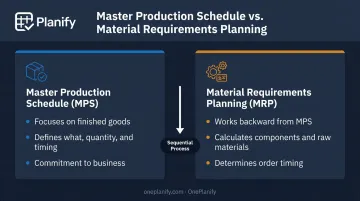
The Master Production Schedule states what will be produced, in what quantity, and by when. It focuses on finished goods and delivery timing. Manufacturing treats it as the commitment to the business about what's coming off the line and when.
Material Requirements Planning takes that MPS and works backward. It calculates the components, sub-assemblies, and raw materials needed to support the build, including how much to order and when to order it.
Put simply: MPS drives what and when to build at the finished-goods level, while MRP determines what materials are needed and when to order them to support that build. They're sequential, not interchangeable.
Capacity Planning: Is It Actually Feasible?
Neither the MPS nor MRP means much if the shop can't physically execute it. That's where capacity planning comes in, through two checks.
Rough-Cut Capacity Planning (RCCP) checks the MPS against key resources before it's finalized, while Capacity Requirements Planning (CRP) validates MRP outputs against detailed labor and machine-center availability.
When capacity and scheduling data aren't accurately fed back into the MPS and MRP process, plans look sound on paper but fall apart on the floor. That gap is exactly why execution steps, covered next, matter as much as the planning itself.
The Three Planning Horizons in Manufacturing Planning and Control
MPC systems operate across three distinct time horizons, each with its own scope and decision-makers:
| Horizon | Focus | Typical Decisions |
|---|---|---|
| Long-term | Strategic capacity | Facility investments, technology upgrades, supplier network |
| Intermediate-term | Aggregate supply/demand | S&OP, volume and product mix, workforce and inventory levels |
| Short-term | Daily execution | Machine and labor scheduling, material availability, order sequencing |
- Long-term decisions rest with executives and finance teams, planning 2-5 years ahead.
- Intermediate-term decisions belong to Sales & Operations Planning (S&OP) teams, working in monthly or quarterly cycles.
- Short-term decisions fall to shop floor schedulers, who replan daily or even hourly.
Each horizon feeds the next. A strategic capacity decision made years out eventually becomes a scheduling constraint someone has to work around next Tuesday. That short-term layer is where scheduling software does its heaviest lifting, turning capacity and S&OP decisions into an achievable sequence on the shop floor.
How an MPC System Works: The Core Process Steps
Once the planning layers are set, an MPC system moves through a recurring cycle of execution steps. These typically play out in this order:
- Planning: Establishes what will be produced, by whom, and with what labor, equipment, and material requirements.
- Routing: Determines the sequence and path raw materials follow through machines and workstations to become finished goods.
- Scheduling: Assigns start and end times to each operation, using master, operation, or daily schedules to manage timing.
- Loading: Compares total workload against available machine and worker capacity to spot overloads or underloads before they turn into bottlenecks.
- Dispatching: Releases work orders, materials, and instructions to the floor so employees can begin production per the routing and schedule.
- Follow-up and expediting: Compares actual performance against planned targets, flags delays or bottlenecks, and feeds corrections back into the plan.
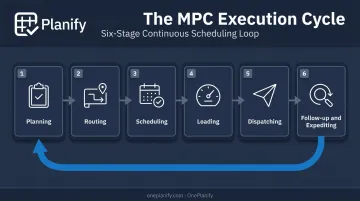
This isn't a one-way pipeline. Follow-up data loops back into planning constantly. A late shipment discovered during follow-up should reshape next week's dispatch decisions, not just get noted and filed away.
Benefits of an Effective MPC System
When these pieces actually connect, the payoff shows up in a few concrete ways:
- Optimized resource utilization – Keeps machines and labor running closer to capacity, reducing idle time and improving profitability
- Reduced inventory costs and better on-time delivery – Tighter demand-supply alignment minimizes excess stock while keeping customer commitments on schedule
- Stronger cross-department coordination – Aligns sales, procurement, and production around one shared plan, cutting down miscommunication-driven delays
The results can be substantial. In one documented case, NIST's Manufacturing Extension Partnership worked with Stainless Works to fix inaccurate capacity data feeding its planning system. After identifying welding as the true bottleneck, the company applied forward scheduling there.
The payoff was measurable:
- Quoted lead time dropped from 12–14 weeks to 5 weeks
- On-time delivery improved
- The company reported $250,000 in increased or retained sales plus $50,000 in cost savings
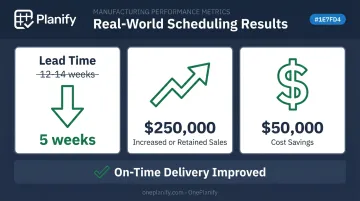
That's one company's result, not an industry average, but it illustrates exactly what's possible when capacity data and scheduling logic actually match reality.
Why Finite Scheduling Is the Missing Link in Modern MPC Systems
Here's the uncomfortable truth about most MPS and MRP outputs: they assume infinite or simplified capacity. The math works out fine on a spreadsheet. It just ignores setups, shift changes, and job dependencies, the exact details that determine whether a schedule survives contact with the actual floor.
Real shop floors are messier than any planning module assumes. Changeovers eat into productive time. Multi-shift handoffs create gaps. Jobs depend on other jobs finishing first. And then a machine breaks down, or a customer calls demanding a rush order, and the whole plan needs rework, fast.
According to Gartner's definition of detailed manufacturing scheduling, this near-term planning covers seconds to weeks, modeling finite capacity, routings, batch sizes, and operational dependencies that ERP master data alone can't capture. That's a different job than MRP planning, and it needs a different tool.
This is the gap OnePlanify was built to close. Its Planify platform layers finite scheduling on top of existing MPS/MRP outputs, without replacing the ERP, handling the specifics that generic scheduling modules skip:
- Sequence-dependent setup times – recognizing that Job A to Job B might take 45 minutes to change over, while Job A to Job C takes 15
- Real shift calendars – with overtime rules and holiday exceptions baked in, so jobs never land on a shift that doesn't exist
- Multi-operation routing enforcement – predecessor locks that stop Op 20 from starting before Op 10 finishes, even after a disruption replan
- Full-board replanning in seconds – with a "Run on Pretend" mode that previews the impact of a machine breakdown or rush order before anyone commits to it
A schedule showing 85% utilization on paper often runs at 60% in practice once real setup time gets factored in. Planify closes that gap directly, sitting alongside ERPs like Epicor, SYSPRO, NetSuite, and SAP Business One as the scheduling layer they typically can't provide on their own.
Frequently Asked Questions
What is manufacturing planning and control (MPC/PPC)?
MPC, sometimes called PPC, is the integrated approach to planning and controlling production resources, materials, machines, and people, to meet customer demand efficiently. It spans everything from strategic capacity decisions down to daily shop floor dispatch.
What's the difference between MPS and MRP in manufacturing planning and control?
The MPS sets what and when to build at the finished-goods level. MRP calculates the materials and components needed, and when to order them, to support that build. One drives the schedule; the other drives procurement.
What are the three types of control plans in manufacturing planning and control?
Long-term planning covers strategic capacity, facilities, and technology decisions. In the intermediate term, S&OP balances aggregate demand against available supply. Short-term planning gets granular, handling day-to-day scheduling and dispatch on the shop floor.
Is an MPC system the same as an ERP system?
No. ERP is a broader, enterprise-wide business system that often includes MPC functionality as one module among many. Dedicated MPC and finite scheduling tools add depth, particularly around real-world capacity constraints, that generic ERP modules typically lack.
What role does finite scheduling play within an MPC system?
Finite scheduling translates the MPC's short-term plan into a realistic, constraint-aware schedule. It accounts for actual shop floor capacity, setups, shift patterns, and disruptions that MPS and MRP outputs generally assume away.