Introduction
Production scheduling is the process of organizing manufacturing tasks, resources, and timing to meet production goals within available capacity. It sounds simple. On a real shop floor, it rarely is.
This guide is written for operations leaders, production planners, and shop floor managers who need to understand scheduling at an operational level, not a textbook one.
Here's the problem: manufacturers often use production scheduling and production planning interchangeably, and that mix-up leads directly to poor implementation on the floor. A plan that looks fine on a whiteboard often falls apart the moment a machine goes down.
This article covers what production scheduling actually is, why manufacturers rely on it, how it works stage by stage, and the methods and real-world factors that shape it.
Key Takeaways
- Production scheduling handles short-term, detailed task timing against finite resources.
- Long-term direction comes from production planning; scheduling drives daily execution.
- Five stages structure the process: planning, routing, scheduling, dispatching, and execution.
- Manufacturers choose between finite/infinite capacity and forward/backward scheduling.
- Effective scheduling manages setups, shift changes, dependencies, and disruptions beyond basic timelines.
What Is Production Scheduling in Manufacturing?
Production scheduling is the short-term, detailed timing and sequencing of manufacturing tasks against available labor, machines, and materials. It answers a very specific question: what gets made, where, when, and with which resources, so due dates get hit without overloading capacity.
The industry group ASCM (formerly APICS) draws a clean line between the two concepts. Planning is "the process of setting goals for the organization and choosing ways to use the organization's resources to achieve the goals." Scheduling, by contrast, is the shorter-horizon act of creating an actual schedule.
That distinction matters more than it sounds:
| Aspect | Production Planning | Production Scheduling |
|---|---|---|
| Time horizon | Quarters or years | Days or shifts |
| Decides | Overall output targets, headcount, and capital investment | Which job runs on which machine, and when |
| Example decision | Add a second shift next quarter | Run Job #482 on Mill 3 at 9 a.m. Tuesday |
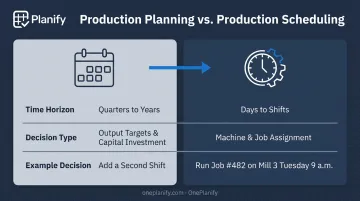
There's also a language trap worth flagging. "A production schedule" is a document, a specific plan for a specific window. "Production scheduling" is the ongoing process of building and adjusting that document as reality changes.
A schedule printed Monday morning is already going stale by Monday afternoon if a machine jams. That's why scheduling needs continuous updates as conditions change on the floor.
Modern scheduling doesn't happen on a whiteboard anymore, or at least it shouldn't. Advanced planning and scheduling (APS) tools exist specifically to execute and maintain this process in real time, applying the rules and constraints below automatically rather than manually. We'll get into how those tools handle complexity later in this article.
Why Production Scheduling Matters in Manufacturing
Manufacturing requires coordinating labor, machines, materials, and deadlines simultaneously, all under finite capacity. Manual guesswork can't reliably do that once a shop is running more than a handful of jobs at once.
Every shop floor demands the same four things from its scheduling approach:
- Consistent output across shifts and departments
- On-time delivery that customers can actually count on
- Tolerance for disruption without the whole plan collapsing
- Synchronization between departments that depend on each other's output
Without disciplined scheduling, the failure modes are predictable:
- Bottlenecks form
- Deadlines get missed
- Machines sit idle while operators wait on materials that haven't arrived
- Work-in-progress piles up in the wrong places
- Stockouts hit at the worst possible moment
Some of this shows up in maintenance data, too. In Plant Engineering's 2020 survey of 171 maintenance professionals, aging equipment was the leading reported cause of unscheduled downtime at 34%, followed by mechanical failure at 20%. Downtime like that ripples straight through a production schedule that wasn't built to absorb it.
Despite that downtime risk, structured scheduling isn't mandated by any regulation; it's simply operational best practice, especially in make-to-order and mixed-mode environments where product mix changes constantly.
Think of the schedule as a translator: sales and demand teams speak in customer commitments and forecasts, while the shop floor speaks in machine hours and labor shifts. The schedule converts one language into the other, turning demand into something the floor can actually execute.
How Production Scheduling Works: The Five-Stage Process
Scheduling starts from a master production schedule and cascades down into department- and task-level timing. It doesn't stop there. It keeps adjusting as conditions change.
Inputs feeding the process include:
- Customer orders and demand forecasts
- Routing data (the sequence of operations a product goes through)
- Resource and capacity data by work center
- Current inventory levels
The core action is sequencing and timing tasks against finite resources, using rules like priority, due date, or minimizing setup changes. Real-time shop floor data feeds back into the process, triggering rescheduling whenever a disruption hits. The result is a live, adjustable schedule that updates continuously, dictating what happens where, when, and by whom.
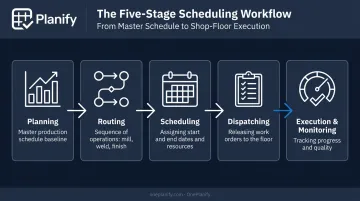
Here's how that plays out across five stages.
Planning: This stage forecasts demand, assesses capacity and budget, and forms a master production schedule as the baseline everything else builds from. It's the highest-altitude view in the whole process.
Routing: Routing maps the sequence of operations raw materials pass through to become a finished product. Think mill, then weld, then finish. The goal is optimizing for the most efficient path through those steps.
Scheduling: This is where specific start and end dates, plus specific resources, get assigned to each routed step. Planners apply forward, backward, finite, or infinite logic here (more on those methods below).
Dispatching: Dispatching releases work orders to the floor. It also confirms that resources and materials are physically available before work begins.
Execution and Monitoring: Production runs against the schedule while teams track progress and quality. Any deviation, a late material delivery, a quality hold, gets fed back into the plan in real time rather than discovered at the next status meeting.
Production Scheduling Methods and Key Factors That Affect It
Scheduling isn't a one-time event. It recurs continuously across make-to-order, make-to-stock, and mixed environments, triggered whenever new orders land, disruptions hit, or demand shifts.
Finite vs. Infinite Capacity
| Approach | How it works | Best suited for |
|---|---|---|
| Infinite capacity | Assumes unlimited resources when calculating load | Rough, long-term planning |
| Finite capacity | Respects real constraints: shift hours, machine availability, labor | Actual shop floor execution |
Finite capacity is the standard for anything that needs to run, not just look good on a spreadsheet.
Forward vs. Backward Scheduling
- Forward scheduling starts from the earliest available date and calculates forward to a completion date.
- Backward scheduling works from the due date and calculates backward to find the latest acceptable start.
Many manufacturers blend both, using backward scheduling for urgent customer commitments and forward scheduling for jobs with more breathing room.
What Actually Breaks Scheduling Accuracy
Five factors consistently determine whether a finite schedule holds up in practice:
- Setup and changeover times between jobs, which vary depending on sequence
- Shift patterns and labor availability, including overtime rules and holiday closures
- Job dependencies and routing complexity, where one operation can't start until another finishes
- Material readiness, since a perfect schedule means nothing if the stock isn't there
- Unplanned disruptions, like breakdowns or rush orders that need to be absorbed without dropping constraints
This is exactly where finite scheduling gets hard on real shop floors, and it's why purpose-built tools exist for this specific job. OnePlanify's Planify platform, for example, handles these constraints directly:
- Models sequence-dependent setup times between job pairs (Job A to Job B might need 45 minutes, Job A to Job C only 15)
- Enforces shift calendars per work center so jobs never land on a shift that doesn't exist
- Locks predecessor operations so Op 20 can't start before Op 10 finishes, even after a full replan
When a machine breaks down or a rush order comes in, that replan happens in seconds through a "Pretend Mode" that lets a planner test a few responses before committing to one. None of this requires a dedicated scheduling specialist on staff to operate day to day.
Common Mistakes, Misconceptions, and Choosing the Right Approach
The most common misconception is treating production scheduling and production planning as the same activity. The result is a schedule that's either too rigid to adjust or too high-level to actually execute against.
The second trap is relying on spreadsheets for finite scheduling once operations scale. Spreadsheets fall short in predictable ways:
- Can't model sequence-dependent setup times
- Can't enforce routing dependencies
- Can't flag an impossible sequence, like a downstream operation starting before its predecessor finishes
That's usually the exact moment foremen stop trusting the published schedule and start running the floor from memory instead.
There's also a persistent confusion between "the schedule" and "scheduling" itself:
| Term | What It Means |
|---|---|
| The schedule | A snapshot, a plan for right now |
| Scheduling | The continuous process of keeping that snapshot accurate |
An unupdated schedule after a disruption isn't neutral. It's actively misleading, because everyone downstream assumes it still reflects reality.
That said, finite scheduling software isn't always necessary. Stable, low-mix operations with predictable demand and few dependencies can run fine on simplified or infinite scheduling; detailed finite logic would be overkill there.
For everyone else, the takeaway is straightforward: treat production scheduling as a continuous, resource-constrained process, not a calendar you print once a week. That mindset is what separates manufacturers who hit delivery targets from those who spend their days firefighting.
Frequently Asked Questions
What is manufacturing scheduling?
Manufacturing scheduling is the process of timing and sequencing production tasks against available labor, machines, and materials to meet delivery goals. It turns a broader production plan into a day-by-day, shift-by-shift execution timeline.
What does a manufacturing scheduler do?
A scheduler builds and adjusts the production timeline, allocates resources, and reacts to disruptions to keep orders on track. This mirrors the federal role of Production, Planning, and Expediting Clerks, who coordinate work and revise schedules around shortages.
What manufacturing scheduling methods are used?
The most common methods are finite and infinite capacity planning, plus forward and backward scheduling. Finite capacity and backward scheduling tend to dominate in due-date-driven, make-to-order environments.
What is the difference between production planning and production scheduling?
Planning is long-term and strategic, setting goals and resource-use choices across quarters or years. Scheduling is short-term, detailed, and execution-focused, dealing with specific days and shifts.
What is production scheduling software?
Production scheduling software, often called APS, automates sequencing, resource allocation, and real-time adjustments beyond what spreadsheets can handle. Gartner defines APS as software that manages multiple constraints while synchronizing material flow through manufacturing.
Why is production scheduling important for manufacturers?
It ties directly to on-time delivery, efficient use of labor and machines, and reduced downtime and waste. Without it, capacity gets guessed at rather than managed, and guessing tends to show up as missed deadlines.