Introduction
Ten jobs, five machines, one fixed order: cutting, welding, painting, assembly, packaging. Flow shop scheduling is the method for choosing which job goes first, second, and last through that line to finish the batch as fast as possible.
This matters for manufacturing planners, operations managers, and production schedulers because getting that sequence wrong doesn't just slow one job down. It ripples across throughput, on-time delivery, and machine utilization for the entire line.
Here's the problem: "flow shop scheduling" gets thrown around loosely on shop floors, often confused with job shop scheduling or lumped in with generic "scheduling software." Many teams have never seen the actual math behind it.
This article breaks down how flow shop scheduling works, what factors affect it in practice, where it applies, and when it's the wrong model entirely.
Key Takeaways
- Flow shop scheduling routes jobs through a fixed machine order to minimize makespan, the total run time
- It fits standardized, high-volume production with low variety, not custom job-to-job routing
- Exact solutions become computationally infeasible fast, so shops rely on heuristics like Johnson's Rule and NEH
- Setup times, machine breakdowns, and rush orders can wreck a theoretically perfect schedule
- Job shop scheduling is a different model, built for variable routings instead of fixed ones
What Is Flow Shop Scheduling?
Flow shop scheduling is a mathematical model for sequencing n jobs across m machines, where every job requires the same series of operations, in the same order. The scheduler's job is to figure out which order to release the jobs in so the whole batch finishes as quickly as possible.
The target most flow shop models optimize for is makespan — the total elapsed time between starting the first job and finishing the last. Minimize makespan, and you've generally maximized machine utilization and minimized idle time in the process.
In practice, the goal is simple: an ordered job sequence that keeps every machine running and clears the batch in the shortest possible window.
Permutation flow shop is the version you'll encounter most often. It adds one constraint: the job order has to stay identical at every machine stage. Job A goes first on machine 1, first on machine 2, first on machine 3, and so on.
This constraint is what makes the problem representable as a simple ordered list, which is also why most scheduling algorithms are built around it.
Flow Shop vs. Job Shop Scheduling
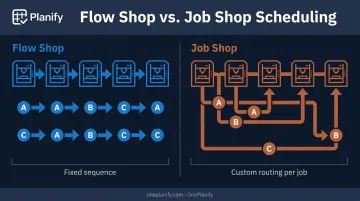
The core difference comes down to routing:
| Aspect | Flow Shop | Job Shop |
|---|---|---|
| Routing | Same fixed path for every job | Custom path per job |
| Machine order | Identical sequence across all jobs | Varies job to job |
| Best fit | Repetitive, standardized production | Custom, one-off orders |
This distinction isn't academic. It's why flow shops lend themselves to mathematical and heuristic optimization, while job shops usually need more dynamic, visual scheduling tools that can handle constantly shifting routings.
Think of an assembly line stamping out one product design all day: fixed sequence, fixed machines, flow shop. Now picture a custom machine shop building one-off parts to spec, where job #47 might need a lathe and a grinder while job #48 skips both and needs a completely different setup. That's job shop territory. Advanced Technology Services breaks down this distinction in more detail if you want a side-by-side comparison.
Why Flow Shop Scheduling Is Used in Manufacturing
Flow shops exist because certain production environments demand predictability. Once a line is set up to run one product type through fixed stages, repeatability is the whole point. Flow shop scheduling is simply the discipline of optimizing that stable, known sequence rather than leaving job order to guesswork.
Manufacturers lean on it to:
- Maximize machine utilization across every stage of the line
- Reduce idle time between operations
- Hit throughput targets in high-volume, low-variety production
Without a structured schedule, predictable problems show up fast:
- Bottlenecks form at the slowest machine while others sit idle
- Machine loading becomes uneven, with some stations overworked and others underused
- Makespan inflates because job order was never actually optimized, just run in whatever sequence orders arrived
- Rush orders trigger costly expediting that disrupts the entire line
Yet none of this is regulatory. No standards body requires flow shop scheduling. It's an operational best practice that manufacturers adopt because it works. It's foundational in industries like electronics assembly, chemical processing, and general assembly-line manufacturing where the same stages repeat job after job.
How Flow Shop Scheduling Works (Conceptual Flow)
At a conceptual level, flow shop scheduling starts with known information: every job's processing time on every machine is documented upfront. The scheduler then searches for the job order that produces the shortest possible makespan.
Inputs typically include:
- Number of jobs and number of machines
- Per-operation processing times for each job
- Constraints such as setup times, precedence rules, or release dates
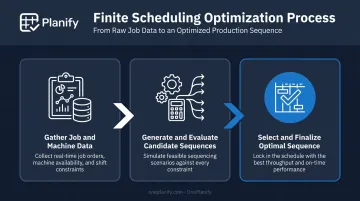
The core transformation is straightforward in theory: generate candidate job sequences, calculate makespan for each, and select the best one. In practice, this is where things get complicated fast.
For a permutation flow shop, The end result of this whole process is a finalized job sequence, usually visualized as a Gantt chart showing exact start and end times per machine. Finite scheduling platforms, like OnePlanify, run these same heuristics in the background, generating that sequence automatically instead of leaving planners to work it out by hand.
Step 1: Gather Job and Machine Data
Before any sequencing happens, someone has to collect the raw inputs: processing times per job per machine, the fixed machine order, and any known constraints like setup times or release dates. Skip this step or use stale data, and every downstream calculation is built on sand.
Step 2: Generate and Evaluate Candidate Sequences
This is where Johnson's Rule, NEH, or a genetic algorithm actually runs. The method generates promising job orderings and calculates the resulting makespan for each one, narrowing down toward a strong candidate sequence.
Step 3: Select and Finalize the Optimal Sequence
The sequence with the lowest makespan (or best result against whatever objective was chosen) gets selected, converted into an actual schedule, and pushed to the shop floor to guide execution.
Where Flow Shop Scheduling Is Applied & What Affects Its Accuracy
Flow shop scheduling shows up wherever production runs through fixed, repeated stages:
- Assembly lines building one product configuration at a time
- Chemical and process plants with sequential batch stages
- Printing and packaging lines
- Computer job-processing pipelines with fixed stage order
It's applied during production planning, before jobs hit the floor, and it's rarely a one-time exercise. Most manufacturers re-run it daily or weekly as new orders arrive and the job mix shifts.
Several real-world factors determine how accurate a flow shop schedule actually is:
- Sequence-dependent setup times: changeover duration often depends on which job ran before it, not a flat average
- Machine availability and reliability: breakdowns and planned maintenance windows can invalidate a static sequence overnight
- Buffer and storage capacity between machines: limited buffers force jobs to wait or block upstream operations entirely
- Number of jobs and machines: the solution space grows factorially, which determines which solving method is even practical
- Whether the tool accounts for shift patterns and floor disruptions that pure mathematical models tend to ignore
That last point is where a lot of theoretical schedules fall apart in practice. A textbook flow shop model assumes machines run continuously and setup times are negligible. Real shop floors don't work that way.
This is the gap platforms like OnePlanify are built to close. Its Planify engine models shift calendars per work center, including first, second, and third shift definitions, so a job never gets scheduled onto a shift that doesn't exist.
It also treats setup times as sequence-dependent rather than fixed. Job A to Job B might take 45 minutes to change over, while Job A to Job C takes only 15 minutes. Most spreadsheet schedules flatten that gap into a single average, quietly turning an "85% utilized" line on paper into a 60% utilized line in reality.
The same discipline extends to multi-operation routing: dependencies like Op 10 → Op 20 → Op 30 are enforced through a predecessor lock, meaning no downstream step can start before its upstream step finishes, even after a full disruption-driven replan.
Common Issues, Misconceptions, and When Flow Shop Scheduling Isn't the Right Fit
Misconception #1: Flow shop scheduling always finds the "optimal" answer.
It doesn't, at least not in most real applications. Exact algorithms only work for small or narrowly defined cases, such as the two-machine problem solved by Johnson's Rule. Beyond that, heuristics get close to optimal but carry no guarantee.
Misconception #2: Minimizing makespan automatically improves on-time delivery.
These are separate objectives. Makespan tracks total completion time for the batch; on-time delivery tracks whether individual jobs hit their due dates. A schedule can post an excellent makespan while several jobs still ship late. Choose the objective that actually matches what the business needs to hit.
Misconception #3: Processing times and setups are fixed constants.
Teams often build schedules assuming stable processing times and negligible setups. Real shop floors have variability, breakdowns, and setup times that swing based on job sequence. A well-documented no-wait flow shop example shows optimal makespan getting worse, from 14 to 15, when a machine's speed doubles. It's a reminder that intuitive assumptions can break down fast in constrained models.
These misconceptions share a common root: treating flow shop scheduling as a universal fit. Sometimes it simply isn't the right tool for the job.
When flow shop scheduling is the wrong fit:
- Highly customized, low-volume production where job routings vary: that's job shop territory
- Demand too volatile for a fixed sequence to hold up week over week
- A business forcing every job through identical steps despite growing product variety — a signal to rethink the framing, not double down
Conclusion
Flow shop scheduling sequences jobs through a fixed machine order to minimize makespan, using heuristics or dedicated software once exact solutions become computationally out of reach. Understanding the model matters because misapplying it, or ignoring shop-floor realities like sequence-dependent setups and machine downtime, produces a schedule nobody can actually run.
Correct application matters more than chasing a theoretical optimum. Pairing the right model with a tool that handles setups, shift calendars, and disruption replanning, like OnePlanify, is what keeps a flow shop line moving.
Frequently Asked Questions
What is flow shop scheduling?
Flow shop scheduling sequences n jobs through m machines in the same fixed order to minimize makespan, the total time from the first job's start to the last job's completion. It's most common in standardized, high-volume production.
What is an example of a flow shop scheduling process?
An assembly line is the classic example: every product moves through cutting, welding, painting, and packaging in that exact order. The scheduling question is simply which product order to run through those stages first.
What is the difference between flow shop and job shop scheduling?
Flow shop uses one fixed machine routing for every job. Job shop allows each job its own custom routing, which is why job shops need more flexible, dynamic scheduling tools rather than fixed sequencing rules.
What is makespan and why does it matter in flow shop scheduling?
Makespan is the total elapsed time from start to finish across all jobs. It matters because shorter makespans mean higher throughput, so most flow shop scheduling methods are built specifically to minimize it.
Is flow shop scheduling always solved with an exact algorithm?
No. Exact methods like Johnson's Rule only work for simple cases, such as two machines. Larger problems are NP-hard, so manufacturers rely on heuristics like NEH or metaheuristics like genetic algorithms instead.
What industries commonly use flow shop scheduling?
Electronics assembly, automotive manufacturing, chemical and process plants, printing, and packaging all rely on flow shop scheduling wherever production runs through the same standardized stages repeatedly.