Introduction
Manufacturers spend their days trying to keep two moving targets aligned: what the shop floor can actually build and what inventory can actually support.
When scheduling and stock control run on separate systems, the cracks show up fast. A machine sits idle waiting on a part nobody flagged. A warehouse fills up with stock nobody had a job for.
This isn't a rare problem. 70% of manufacturers still collect or enter at least some production data manually, according to research from the Manufacturing Leadership Council, which means most plants are still bridging planning and inventory with spreadsheets and guesswork.
Integrated production planning and inventory management software closes that gap. It syncs schedules with real stock levels, so planners spot disruption before it stops a line. Below, we rank the 10 platforms best suited to different sizes and complexity levels of U.S. manufacturing operations.
TL;DR
- Combines scheduling, material tracking and demand forecasting in one platform.
- The right fit depends on complexity: lightweight MRP, full ERP, or finite scheduling tools like OnePlanify
- Key ranking factors: scheduling flexibility, inventory visibility, integrations, scalability and ease of use
- This guide covers 10 top platforms spanning startups to enterprise plants
Overview of Production Planning and Inventory Management Software in Manufacturing
Production planning and inventory management software brings scheduling and stock control into a single system, so a change on one side automatically updates the other. Without that link, planners work off numbers that are already stale by the time they act on them.
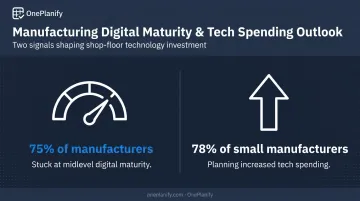
Adoption is accelerating, but unevenly. According to NAM's 2025 research, 75% of manufacturers have only reached a "midlevel" of digital maturity — most plants have started digitizing but haven't connected planning and inventory data end to end.
On the small-business side, 78% of companies with 1-99 employees planned to increase technology spending, per IDC MarketScape research. Half named ERP and financial-management tools a top priority.
That gap between where manufacturers are and where they need to be is exactly why picking the right platform matters. The list below covers options for startups running their first work orders through to enterprise plants with multi-shift, multi-line complexity.
Top 10 Production Planning and Inventory Management Software
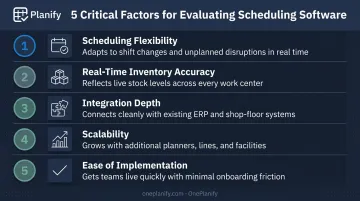
We ranked these platforms on five factors that consistently separate tools manufacturers keep using from tools they abandon within a year:
- Scheduling flexibility: can it handle setups, shift patterns and dependencies, not just a generic calendar?
- Real-time inventory accuracy: does stock update automatically as production moves?
- Integration capability: does it connect cleanly with existing ERP, accounting or e-commerce tools?
- Scalability: will it still work as order volume or SKU count grows?
- Ease of implementation: how long until a team is actually running it, not just configuring it?
OnePlanify
OnePlanify's Planify platform is purpose-built for finite scheduling: it handles the setups, shift changes, work-order dependencies and last-minute disruptions that make most generic scheduling tools fall apart on a real shop floor.
Most ERP scheduling modules assume infinite capacity and take months to configure. Planify sits between Excel and a full ERP rollout: a "spreadsheet-familiar workspace" planners can run in weeks, not quarters. Its standout feature, Run on Pretend, lets planners model a machine breakdown or rush order, test a few response scenarios, and pick the least damaging one before committing anything to the live schedule.
It integrates with nine major manufacturing ERPs (including Epicor, SYSPRO, NetSuite, Infor, JobBOSS, Global Shop, Odoo and SAP Business One), pulling work orders and routings, then dispatching sequenced operations back without replacing the ERP itself.
| Category | Details |
|---|---|
| Pricing | Contact OnePlanify for a scoping meeting and quote |
| Key Features | Finite scheduling, setup/changeover handling, shift-aware calendars, dependency management, real-time disruption rescheduling |
| Best For | SMB manufacturers needing detailed, flexible shop floor scheduling without a full ERP rollout |
Katana MRP
Katana is built for small-to-mid-sized manufacturers who need to see production and inventory move together, in real time, without a spreadsheet in between.
Its dashboard shows live stock across locations, and inventory levels adjust automatically as manufacturing orders progress. Native Shopify integration syncs sales orders across multiple stores, while Xero and QuickBooks connections push invoices and bills directly from production activity.
| Category | Details |
|---|---|
| Pricing | Free for up to 30 SKUs; Core starts at $299/month for unlimited SKUs |
| Key Features | Live inventory tracking, reorder point alerts, work order and manufacturing order management |
| Best For | Small-to-mid manufacturers running made-to-order or just-in-time workflows |
SAP Business One
SAP Business One is a scalable ERP for mid-sized manufacturers that have outgrown spreadsheets but don't need enterprise-scale SAP infrastructure.
Its MRP Wizard evaluates demand and supply, then recommends production orders, purchase orders and inventory transfers, back-scheduled against defined lead times. It also handles batch and serial tracking with full valuation support. The tradeoff: getting the most out of it typically requires a consultant, since configuration isn't quick.
| Category | Details |
|---|---|
| Pricing | Quote-based, dependent on modules selected |
| Key Features | MRP wizard, batch/serial tracking, purchase order recommendations, cross-department inventory visibility |
| Best For | Mid-sized manufacturers needing an integrated ERP beyond spreadsheets |
Odoo
Odoo takes a different approach entirely: pick only the apps you need. Its Inventory and Manufacturing modules can run standalone or alongside the rest of the suite.
The Community edition is free and open source. Businesses that want the full suite pay $24.90-$49.00 per user/month on annual billing, scaling up with features like Odoo Studio and multi-company support. Barcode scanning covers lot and serial numbers, including GS1-compatible codes — though that capability sits in the paid Enterprise tier, not Community.
| Category | Details |
|---|---|
| Pricing | Free (Community); paid plans from $24.90/user/month (annual billing) |
| Key Features | Customizable inventory and manufacturing apps, barcode scanning, batch/lot tracking |
| Best For | Growing manufacturers wanting a low-cost, customizable ERP alternative |
Fishbowl Inventory
Fishbowl is aimed squarely at QuickBooks-centric small-to-mid manufacturers who need inventory control that doesn't fight their accounting system.
It offers two-way QuickBooks and Xero sync, part tracking, and barcode scanning for work orders. Fishbowl Advanced adds a production scheduling module with Gantt-style views for rescheduling work orders, a step up from basic list-based planning, though it's still lighter on advanced workload balancing than dedicated scheduling tools.
| Category | Details |
|---|---|
| Pricing | Cloud plans from $229/month (Essentials) up to $729/month (Scale); Advanced starts at $595-$675/month |
| Key Features | Work order management, barcode scanning, QuickBooks/Xero integration |
| Best For | Small manufacturers wanting inventory control tightly linked to accounting |
MRPeasy
MRPeasy targets startups and small manufacturers that need production scheduling and inventory in one affordable, cloud-based place.
Its production schedule offers both calendar and Gantt chart views, with drag-and-drop rescheduling of manufacturing orders. Combined with native QuickBooks and Xero integration, it's a genuinely simple entry point for teams moving off spreadsheets for the first time.
| Category | Details |
|---|---|
| Pricing | $49-$149/user/month, billed monthly (one month free on annual billing) |
| Key Features | Order management, BOM tracking, Gantt/calendar scheduling, real-time inventory visibility |
| Best For | Small manufacturers and startups seeking a simple, affordable MRP |
Microsoft Dynamics 365 Business Central
Business Central is enterprise-grade ERP with AI baked into the forecasting layer, aimed at larger manufacturers running complex inventory operations.
Its Sales and Inventory Forecast extension uses Azure AI and historical sales data to flag expected stockouts before they happen, feeding directly into replenishment requests. Planning worksheets then calculate what to reorder, how much and when. The catch: setup and configuration are genuinely complex, and most manufacturers implement through a Microsoft partner rather than solo.
| Category | Details |
|---|---|
| Pricing | Essentials $80/user/month; Premium $110/user/month (paid yearly) |
| Key Features | AI-powered sales forecasting, automated replenishment planning, Microsoft ecosystem integration |
| Best For | Enterprise manufacturers with complex, high-volume inventory needs |
QT9 ERP
QT9 ERP combines inventory, production and quality management in one cloud-native system, which makes it a strong fit for regulated manufacturers who can't treat compliance as an afterthought.
Its Purchased Inventory Control module gives full lot and serial-number traceability, while the purchasing module automates supplier orders and procurement tracking. Every quote bundles in unlimited training and support plus free upgrades, a meaningfully different pricing philosophy than most ERP vendors.
| Category | Details |
|---|---|
| Pricing | Custom quote based on users and deployment; includes unlimited training/support |
| Key Features | Real-time multi-warehouse tracking, lot/serial traceability, purchasing automation |
| Best For | Manufacturers wanting inventory and quality compliance managed together |
Cin7
Cin7 fits manufacturers who build products and sell them across multiple channels, physical and digital.
It syncs inventory in real time across sales channels and pairs that with ready-to-deploy EDI integrations, which shortens the fulfillment cycle between a production run and a shipped order. That combination makes it less of a pure production tool and more of a bridge between manufacturing and retail operations.
| Category | Details |
|---|---|
| Pricing | Core plans from $349/month (Standard) to $999/month (Advanced); Omni is custom-quoted |
| Key Features | Inventory, warehouse and order management; e-commerce and EDI integrations |
| Best For | Manufacturers also managing direct sales channels alongside production |
How We Chose the Best Production Planning and Inventory Management Software
The most common mistake buyers make is picking software based on brand recognition or sticker price. Months later, they discover it can't handle their actual shop floor: setups, changeovers, shift patterns, and the disruptions that hit every week.
We weighted five factors against real business outcomes:
- Scheduling flexibility: tools that ignore setup times or shift calendars produce plans that look good on paper but fail on the floor, driving up downtime
- Real-time inventory accuracy: stale stock data leads directly to stockouts or overproduction
- Integration depth: a platform that fights your ERP or accounting system adds work instead of removing it
- Scalability: software that can't grow with SKU count or order volume becomes a replacement project within a year
- Ease of implementation: a six-month rollout delays every benefit the software was supposed to deliver
Platforms that scored well across all five consistently improved on-time delivery and cut carrying costs. Ones that scored well on only price or brand name tended to get abandoned by planners within the first year.
Conclusion
The best platform for your shop floor depends entirely on its actual complexity, not a one-size-fits-all pick. A startup running a handful of SKUs doesn't need enterprise ERP overhead, and a multi-shift plant with sequence-dependent changeovers won't get far on a basic calendar tool.
Before committing, weigh scalability, integration needs and total cost of ownership, not just the sticker price on the pricing page.
If your biggest headache is finite scheduling around setups, shift changes and constant disruptions, OnePlanify is worth a look. It's purpose-built for exactly that problem, without the months-long rollout a full ERP scheduling module demands.
Frequently Asked Questions
What software is used for production planning and inventory control?
Manufacturers typically use broad ERP/MRP platforms like SAP Business One or Odoo for company-wide operations. When shop floor scheduling complexity is the main pain point, dedicated finite scheduling tools like OnePlanify are a better fit.
What are the 4 types of inventory control?
The four common methods are just-in-time (JIT), economic order quantity (EOQ), perpetual inventory management and material requirements planning (MRP). Each addresses a different part of stock timing and cost control.
What is the difference between production planning software and inventory management software?
Production planning software schedules tasks, resources and timelines. Inventory management software tracks stock levels and material availability. The best manufacturing platforms combine both into one connected system.
How much does production planning and inventory management software typically cost?
Pricing ranges from roughly $49-$150 per user/month for small cloud MRP tools to custom enterprise quotes for full ERP suites. Weigh the sticker price against implementation time and expected ROI.
Can small manufacturers benefit from production planning software?
Yes. Lightweight, affordable tools exist specifically for startups and small manufacturers. Even basic scheduling and inventory automation cuts errors and delays compared to spreadsheets.
What features should I look for in production planning and inventory management software?
Look for real-time inventory visibility, scheduling that accounts for setups and shift changes, solid ERP/accounting integrations, and room to scale as your operation grows.