
Introduction
A machine that's powered on isn't necessarily a machine that's producing. That gap between "turned on" and "actually running" trips up more manufacturers than most would like to admit.
Planned time and productive time are not the same thing, and confusing the two hides real losses on the shop floor.
Machine availability is the metric that closes that gap. It's one of three pillars behind Overall Equipment Effectiveness (OEE), alongside performance and quality, and it's often the first place manufacturers find hidden capacity.
This article covers the definition, the formula, a step-by-step calculation, how availability differs from uptime and reliability, what typically drags it down, and practical ways to raise it.
Key Takeaways
- Availability measures the percentage of planned production time a machine actually runs
- The core formula: Availability = Run Time / Planned Production Time x 100%
- It's one of three OEE components, multiplied by performance and quality
- Downtime, planned or unplanned, drives most availability losses
- Smarter scheduling and maintenance planning deliver the biggest availability gains
What Is Machine Availability?
Machine availability is the proportion of planned production time that a machine spends actually running and producing. Not powered on. Not idling between jobs. Actually producing.
Planned production time isn't the full 24-hour clock. It's scheduled shifts minus:
- Planned shutdowns (holidays, no-demand periods)
- Scheduled maintenance windows
- Periods where there's no work assigned
Everything left over is the time a machine is expected to run. Availability tells you what fraction of that expected window it actually ran.
This matters because availability is a leading indicator of shop floor health. Low availability points to a downtime problem, whether that's breakdowns, changeovers eating into run time, or gaps in scheduling.
High availability signals a floor where machines run when they're supposed to — a solid foundation for tackling performance and quality issues next.
What Are the Three Types of Availability?
Reliability engineering, per the long-standing military handbook MIL-HDBK-338B, recognizes three distinct flavors of availability. Each draws its boundary line around downtime differently:
- Inherent Availability: A theoretical, design-based figure. It only accounts for corrective maintenance time (repairs) and ignores logistics or administrative delays. It answers, "How good is this machine's design?"
- Achieved Availability: Adds preventive maintenance downtime into the mix, but still excludes logistics and administrative delays. It's closer to reality but still assumes ideal support conditions.
- Operational Availability: The real-world number. It includes every downtime type: active maintenance, logistics delays, waiting on parts, and administrative holdups.

Operational availability is the version most shop floors track, and it's the one baked into OEE calculations. It reflects what's actually happening, not what's theoretically possible.
Machine Availability Formula: How to Calculate It
The standard formula, confirmed in a 2023 ISA resource on OEE, is straightforward:
Availability % = Run Time / Planned Production Time x 100%
There's also a downtime-based version that gets to the same answer:
Availability % = 100% – Downtime %
This shortcut only works when Downtime % uses the same planned-production denominator as Availability. Mixing in calendar time or a different reporting window will throw off the math.
Calculating It Step by Step
- Identify planned production time. Total scheduled time minus planned shutdowns and maintenance.
- Log all downtime with reasons. Breakdowns, changeovers, material shortages, anything that stopped the machine.
- Calculate run time. Planned production time minus total stop time.
- Apply the formula. Divide run time by planned production time, multiply by 100.
Worked example:
| Metric | Value |
|---|---|
| Planned Production Time | 480 minutes |
| Stop Time | 30 minutes |
| Run Time | 450 minutes |
| Availability | 93.75% |
Run 450 minutes divided by planned 480 minutes, multiply by 100, and you land at 93.75%. Cross-check with the downtime method: 30/480 = 6.25% downtime, and 100% minus 6.25% gets you the same 93.75%.
How to Check Machine Availability
Two approaches dominate here:
| Tracking Method | How It Works | Key Risk |
|---|---|---|
| Manual/paper tracking | Operators log stops on a clipboard or spreadsheet | Cheap to start, but short stops and forgotten entries vanish from the record |
| Automated tracking | Sensors, PLCs, or monitoring software capture run and stop states continuously | Requires upfront setup, but catches everything |
The accuracy gap between the two is significant. Manual logs tend to understate downtime because operators don't record every micro-stop, while automated systems catch everything, including the five-minute pauses that add up across a shift.
Machine Availability vs. Uptime vs. Machine Reliability
These three terms get used interchangeably on the floor, but they answer different questions.
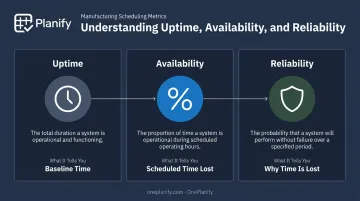
- Uptime is a raw time quantity: the hours or minutes a machine was physically capable of running, without context for what it should have been doing.
- Availability turns uptime into a percentage against planned production time, showing how well that scheduled time was used.
- Reliability measures the probability of failure-free operation, covering breakdowns, jams, and unplanned stops within a given interval.
Here's the counterintuitive part: a machine can be highly available while still being unreliable. Think of equipment that breaks down often but gets repaired in minutes each time. Frequent short repairs can still add up to a high availability percentage, even though the underlying reliability is poor.
Tracking all three together, rather than picking a favorite, gives a fuller picture.
| Metric | What It Tells You |
|---|---|
| Uptime | The raw baseline the other two metrics are built from |
| Availability | How much scheduled time you're losing |
| Reliability | Why you're losing it |
Common Factors That Reduce Machine Availability
Downtime splits into two buckets, and each one hits the availability formula differently:
- Planned downtime: Changeovers, scheduled maintenance, and tooling swaps are expected, but poorly managed changeovers still eat into run time.
- Unplanned downtime: Breakdowns, material shortages, and undocumented stops erode availability fastest because they're unpredictable and often underreported.
A 2022 Plant Engineering survey of maintenance professionals found that 80% of respondents cited aging equipment or machine breakdowns as a factor hurting plant productivity. That's not a claim about the exact share of downtime hours, but it's a strong signal about where maintenance teams see the biggest threats.
Scheduling complexity compounds all of this. A few common patterns:
- Juggling multiple jobs across the same machine without accounting for setup time between them
- Shift handoffs where work gets dropped or duplicated
- Machine dependencies, where a downstream operation sits idle waiting on an upstream job
- Last-minute disruptions, like a rush order, that force manual rescheduling and introduce new conflicts
None of these show up as a single dramatic breakdown. They're smaller losses that stack up quietly across a week. A good schedule should be built to avoid these losses, not just react to them.
How to Improve Machine Availability
Three levers move availability the most: maintenance strategy, standardized procedures, and scheduling discipline.
Preventive and predictive maintenance reduce unplanned breakdowns by catching wear before it turns into a failure. This doesn't eliminate planned downtime, but it stabilizes it, so maintenance windows are predictable instead of a surprise that derails the day's schedule.
Standardizing changeover and setup procedures across operators and shifts cuts the variability that quietly erodes availability. If one operator's changeover takes 20 minutes and another's takes 45 for the same job, that gap is pure availability loss with no productivity to show for it.
Scheduling is where a lot of availability gets won or lost, and it's often overlooked in favor of maintenance fixes alone. A schedule that looks 85% utilized on paper can run at closer to 60% in reality once setup time, shift boundaries, and job dependencies get ignored.
This is where a tool like OnePlanify fits in. Its Planify platform is built to model the shop floor as it actually operates, not as a simplified spreadsheet version of it:
- Sequence-dependent setup modeling groups compatible jobs together so machines spend more time producing and less time being retooled
- Shift-aware scheduling places jobs inside real shift calendars, so work never lands on a closed weekend, holiday, or unstaffed third shift
- Predecessor locks prevent downstream operations from starting before upstream work finishes, which stops machines from sitting idle waiting on in-process material
- Disruption replanning resequences the entire schedule board in seconds after a breakdown or rush order hits, while preserving existing setup, shift, and dependency constraints
The real test comes after the schedule is built. When something breaks or a rush order lands, the replan needs to fix that disruption without creating new availability losses along the way.
Frequently Asked Questions
What does machine availability mean?
Machine availability is the percentage of planned production time a machine is actually running and producing, rather than sitting idle or stopped for maintenance, breakdowns, or other delays.
What is the formula for machine availability?
The standard formula is Availability % = Run Time / Planned Production Time x 100%. An equivalent version is 100% minus Downtime %, as long as both use the same planned-time denominator.
How to check machine availability?
Manufacturers track it either manually, through operator logs and paper records, or through automated tools like sensors, PLCs, or monitoring software. Automated tracking generally catches far more downtime than manual logs.
What are the three types of availability?
Reliability engineering defines inherent, achieved, and operational availability, each with a different downtime boundary. Operational availability, which includes all real-world downtime, is what's most commonly tracked in manufacturing and OEE reporting.
What is a good machine availability benchmark?
There's no single universal number. ASQ documents an 85% OEE benchmark specifically for the automotive industry, and good availability targets vary by industry, machine type, and how planned production time is defined.
How does machine availability affect OEE?
OEE is calculated as Availability x Performance x Quality. Because the three factors multiply together, even a modest improvement in availability produces a meaningful lift in the overall OEE score.