Sound familiar? This is what happens on shop floors that run on memory, sticky notes, and hope instead of a real system.
Many manufacturers struggle with exactly this pattern — constant reactive firefighting instead of predictable execution. A schedule gets built once, then reality tears through it within hours. Production Planning and Control (PPC) exists to fix that gap.
This article breaks down what PPC actually means, its core objectives, the steps that make it work, the different types of planning it involves, and how modern scheduling software makes the whole thing executable instead of theoretical.
Key Takeaways
- PPC combines two functions: planning production and controlling execution in real time
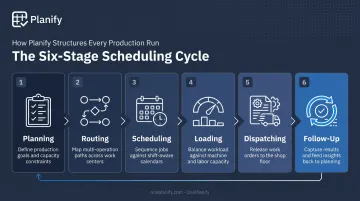
- The commonly cited PPC sequence runs Planning, Routing, Scheduling, Loading, Dispatching, and Follow-up
- Core objectives include continuous flow, proactive resource planning, optimized inventory, and higher on-time delivery
- MPS, MRP, and capacity planning each address a different layer of production planning
- Finite-capacity scheduling tools track disruptions that spreadsheets and rigid ERP modules miss
What Is Production Planning and Control?
Production Planning and Control is the integrated process of deciding what to produce, in what quantity, and by when, then coordinating the people, machines, and materials needed to execute that plan while correcting deviations as they surface.
A British Standard definition, reproduced by IGNOU's manufacturing coursework, frames it this way: a manufacturing plan is determined, the information needed to execute it is issued, and operating data is collected throughout production to keep the plant under control (IGNOU). That's the whole discipline in one sentence: plan, execute, measure, adjust.
Production Planning: The "Before" Phase
Planning happens before a single part gets touched. It covers:
- Demand forecasting from sales data
- Materials and procurement planning
- Capacity planning across machines and labor
- Initial scheduling of when work should happen
This phase answers the what, when, and how much, pulling inputs from sales orders, engineering specs, and procurement lead times.
Production Control: The "During and After" Phase
Control kicks in once work starts. It tracks actual performance against the plan and triggers corrective action when reality drifts.
Common control techniques include:
- Progress tracking: comparing completed work against the schedule
- Exception management: flagging jobs that fall behind or run into quality issues
- Schedule adjustment: re-sequencing or re-prioritizing when something breaks
Why Planning and Control Are Interdependent
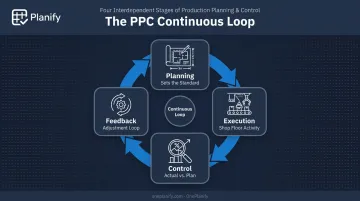
Neither function works alone. Planning sets the standard; control measures against it; deviations get fed back into a revised plan. It's a closed loop: planning informs control, and control reshapes tomorrow's planning.
A 2019 study on high-mix, low-volume manufacturing describes exactly this mechanism: machine data and historical process information get used to continuously update planning parameters, rather than treating the original plan as fixed (ScienceDirect, 2019). In practice, this means every late job, every scrap part, and every unplanned downtime event should change tomorrow's plan, not just today's excuse.
Objectives of Production Planning and Control
PPC theory sounds abstract until it gets translated into goals a plant manager actually tracks every shift. Here's what that looks like in practice.
Ensure Continuous Flow of Production
The goal is to keep materials, machines, and labor moving without bottlenecks stalling the line. NIST's work on lean manufacturing ties this directly to cellular flow design, linking tighter process sequencing to reduced lead time, lower inventory, and faster resolution of quality problems (NIST). Flow depends less on raw speed and more on removing the stop-and-start that batch-and-queue processing creates.
Plan Requirements Proactively
Materials, tools, and capacity get lined up before they're needed, not scrambled for after an order changes. This is the difference between a planner who knows next week's bottleneck today and one who finds out when the line stops.
Optimize Inventory Levels
PPC seeks a balance:
- Too much inventory ties up capital and warehouse space
- Too little inventory risks missed shipments and idle machines
- Just-in-time principles push toward minimal stock, but only work when supply chains run smoothly
Leaning too hard on lean inventory without backup planning raises exposure to disruption. Getting this balance right takes ongoing tradeoffs, not a one-time fix.
Increase Productivity
Running every machine harder doesn't help if the real constraint sits elsewhere. PPC directs resources to the actual bottleneck, the station limiting total throughput, rather than pushing volume through stations that already have slack.
Improve Customer Satisfaction and On-Time Delivery
Late shipments cost real money and real customers. In one documented case, a diagnostics manufacturer working with NIST's MEP program improved on-time delivery by 14% within three months, cut finished-goods inventory by 50%, and projected a 20% sales increase without adding staff (NIST MEP case study). That's one company's result, not an industry average, but it shows what aligning schedules with promise dates can do.
Steps in Production Planning and Control
PPC typically breaks into a sequence of operational steps. Some sources count five, folding loading into scheduling; others separate it out into six. Both are correct, depending on the source; more on that in the FAQ below.
- Planning: Defines what will be produced, by whom, and with what resources, using inputs from sales orders and engineering specs.
- Routing: Determines the path materials follow through the factory, specifying which machines to use and in what sequence, to reach finished goods.
- Scheduling: Assigns time frames to each operation, taking a few forms:
- Master schedule — the overall production timetable
- Operation schedule — timing for each individual process step
- Daily schedule — the day-to-day floor-level plan
- Loading: Balances workload against available machine and labor capacity, flagging overload before it causes a bottleneck, or underload before it wastes capacity.
- Dispatching: Releases actual work orders and instructions to the floor, following the already-set routing and schedule.
- Follow-Up (Expediting): Compares actual performance to plan, identifies bottlenecks or defects, and feeds those findings back into the next planning cycle. This is where the loop closes: follow-up data becomes tomorrow's planning input.
Types of Production Planning and Control
PPC is implemented through several specialized planning layers, each answering a different question about production.
Master Production Schedule (MPS)
Specifies what will be produced, in what quantity, and by what date, such as 500 units of a valve assembly due by the 15th. It's the backbone for meeting delivery commitments and disaggregates broader production plans into item-level detail.
Material Requirements Planning (MRP)
Ensures raw materials are available when needed while minimizing excess stock. MRP uses the MPS, bill of materials, and current inventory status to generate purchasing and production orders.
Capacity Planning
Balances what's available against what demand requires, factoring in cost constraints. A shop with three machines and one shift, for instance, has a fixed ceiling on output regardless of order volume. Capacity planning determines what kind of capacity is needed, how much, and when.
Workflow Planning
Sequences operations and tracks task ownership and completion status across the shop floor. This is where day-to-day execution visibility lives — who's doing what, and where each job stands right now.
Key Characteristics of Production Planning and Control
Effective PPC shares a few defining traits, regardless of industry or plant size.
It's data-driven. Forecasts and real-time production data, not static assumptions from last quarter, drive planning decisions. Demand forecasting gives production planning its foundation in the first place.
It's cyclical and cross-functional. Sales, procurement, and the shop floor all feed into the same loop. Coordination across these groups, sometimes formalized through sales and operations planning, keeps the plan realistic instead of aspirational.
It has to handle real disruption. Setups, shift changes, machine downtime, and last-minute order changes are the norm, not the exception, on any real shop floor.
This last point is exactly the gap that spreadsheets can't close. A spreadsheet schedule that looks 85% utilized on paper often runs closer to 60% once real changeover time gets factored in. Excel simply doesn't model setup sequences, shift calendars, or downstream routing dependencies.
This is the specific problem purpose-built finite scheduling tools like OnePlanify's Planify platform are designed to solve.
Planify models sequence-dependent setup times, enforces real shift calendars per work center, and lets planners run a disruption scenario in "Pretend mode" before committing to it. Replanning an entire schedule takes seconds instead of hours, without dropping the constraints that made the original plan valid.
Frequently Asked Questions
What is production planning and control?
PPC is the combined process of deciding what to produce, when, and in what quantity, then monitoring execution and correcting deviations as they occur. It links pre-production planning with real-time shop-floor control.
What are the five steps of production planning and control?
The most commonly cited sequence is Routing, Scheduling, Loading, Dispatching, and Follow-up, with Planning as the foundational stage before them. Some sources count Planning as a sixth step rather than a separate precursor.
What are the main types of production planning and control?
The primary types are Master Production Schedule (MPS), Material Requirements Planning (MRP), capacity planning, and workflow planning. Each addresses a different layer of what, how much, and when to produce.
What are the key characteristics of production planning and control?
Effective PPC is data-driven, cyclical, and cross-functional, pulling in forecasts, real-time floor data, and coordination across sales and procurement. It also has to adapt to real disruptions like downtime and rush orders.
Why is production planning and control important for manufacturers?
Without it, plants fall into constant reactive firefighting. Good PPC reduces that chaos, improves on-time delivery, and keeps inventory and waste costs under control.
What tools or software support production planning and control?
ERP systems store planning data like work orders and routings, but their scheduling modules typically assume infinite capacity. OnePlanify's Planify closes that gap, managing setups, shift changes, and disruptions directly on top of existing ERP data.