Introduction
Walk onto most shop floors and you'll find the same scene: whiteboards covered in dry-erase marker, three spreadsheets tracking three departments, and one planner who alone knows what's happening on machine 4 today.
It works, until a machine breaks down or a rush order lands. Then the cracks show fast.
Manual tools still dominate shop floors. A recent industry survey found that 68% of manufacturers use Microsoft Excel for data analysis, even as production complexity grows. Fragmented planning across departments creates missed deadlines, duplicated effort, and constant firefighting.
This article breaks down what centralized production planning and control actually means: the steps involved, the five core planning types, and the real benefits. It also covers the challenges manufacturers hit when they try to centralize, and what makes it stick.
Key Takeaways
- Centralized planning unifies scheduling under one system, one data source, and one authority
- The process follows eight connected steps, from planning through inspection and correction
- Five planning types (MPS, MRP, capacity, workflow, S&OP) work together under centralized control
- Real-world results: lead times cut from 12-14 weeks to 5 weeks, plus measurable cost savings
- A hybrid approach, centralized data with local execution flexibility, often works best
What is Centralized Production Planning and Control?
Production planning and control are really two connected jobs. Planning decides what to produce, when, and in what quantity. Control monitors execution against that plan and corrects course when reality drifts from the schedule.
"Centralized" means both functions run through a single point of authority, one system, one dataset, one set of rules, rather than each department or shift building its own plan in isolation.
That's a different concept from centralized manufacturing, which refers to producing goods at one physical facility instead of several. You can centralize planning across multiple plants, or run decentralized planning inside a single building.
The two ideas get confused constantly, but they answer different questions: one is about where you make things, the other is about who controls the decisions.
Key characteristics of centralized planning
- A single source of truth for schedules, capacity, and inventory data
- Standardized scheduling rules applied across every work center
- Unified visibility that runs from sales orders down to the shop floor
- One authority responsible for resolving conflicts between competing priorities
Example: Instead of the machining department, welding supervisor, and finishing team each keeping their own spreadsheet, a plant running centralized planning coordinates every machine, every shift, and every job dependency through one scheduling system. When a rush order comes in, everyone sees the same updated plan at the same time.
The Core Steps in Centralized Production Planning and Control
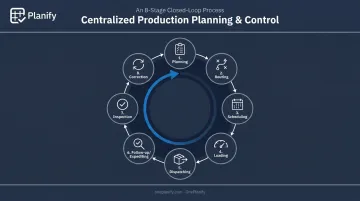
Centralized production planning and control typically follows eight sequential steps. Each one depends on shared data and a single point of authority to function. Decentralized versions of these steps tend to break down at the handoffs between departments.
- Planning defines what gets produced, by whom, and with what resources. Centralized planning consolidates sales forecasts and demand data from across the business, rather than relying on whatever numbers one department happens to have on hand.
- Routing determines the sequence raw materials follow through machines and workstations, for example, mill, then weld, then finish. Centralized routing optimizes that sequence across the entire shop, not just within one department's bubble.
- Scheduling assigns actual time slots to each operation. A centralized scheduling system prevents the same machine or crew from being double-booked by two departments that don't talk to each other.
- Loading balances workload against the real capacity of machines and workers. With centralized visibility, overloaded resources and idle capacity both show up immediately instead of getting discovered after the fact.
- Dispatching releases work orders and instructions to the floor. This step can be centralized, where one authority issues all orders, or decentralized, where individual work centers issue their own. Many shops blend the two.
- Follow-up (Expediting) compares planned performance against what happened, catching bottlenecks before they cascade. Centralized, real-time data makes this far faster than waiting on siloed department reports.
- Inspection verifies output against the original plan, confirming it matches what was scheduled.
- Correction feeds any deviations back into the centralized system, turning a one-time schedule into a continuously improving process.
Five Main Types of Production Planning
Centralized planning doesn't replace these five planning types; it pulls them together so they work from the same dataset instead of five disconnected sources.
The five core types include:
- Master Production Schedule (MPS): Defines what to produce, when, and in what quantity to hit delivery dates. It's the anchor plan everything else builds around.
- Material Requirements Planning (MRP): Ensures raw materials are available when needed while keeping inventory levels lean, answering "do we have what we need" before production starts.
- Capacity Planning: Balances available resources, machines, labor, and time against actual demand and cost. This is where centralized systems earn their keep, since capacity conflicts are exactly what siloed planning misses.
- Workflow Planning: Sequences operations, tracking who owns each task and when it's due. It's the connective tissue between routing and scheduling.
- Aggregate (Sales & Operations) Planning: Aligns production output with overall sales and business goals across a longer planning horizon, focusing on whether capacity matches where the business is headed rather than the day's schedule.
Benefits of Centralizing Production Planning and Control
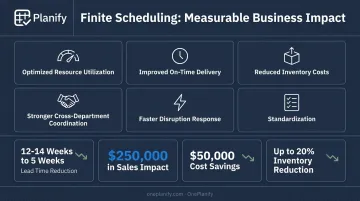
The case for centralization isn't theoretical. A NIST-documented case study of Stainless Works, a performance headers and exhaust manufacturer, found that improving scheduling and capacity planning cut lead times from 12-14 weeks down to 5 weeks. The result: $250,000 in increased or retained sales and $50,000 in cost savings.
Centralizing planning and control delivers these results through several concrete mechanisms:
Optimized resource utilization A single view of capacity across every department and shift reduces idle machine time and unplanned overtime. Planners can see exactly where slack exists instead of guessing.
Improved on-time delivery Centralized scheduling removes the conflicting priorities that pop up when departments plan independently, allowing smarter sequencing and fewer missed customer deadlines.
Reduced inventory costs and waste Centralized MRP and demand data help prevent both overstocking and shortages. McKinsey research on autonomous supply chain planning found companies can reduce inventory by up to 20% and supply chain costs by up to 10% with better planning visibility.
Stronger cross-department coordination Sales, procurement, and the shop floor work from the same schedule instead of siloed spreadsheets that inevitably drift out of sync.
Faster response to disruption When a machine breaks down or a rush order hits, centralized visibility shows planners exactly how it ripples across the whole schedule. Purpose-built finite scheduling tools like OnePlanify close this gap, absorbing setups, shift changes, dependencies, and disruption without the plan falling apart.
Standardization and consistency Shared rules and centralized data reduce variability between shifts or facilities, building repeatable best practices instead of isolated tribal knowledge.
Centralized vs. Decentralized Production Planning
Neither model is universally correct. It depends on how your operation is structured.
| Factor | Centralized Planning | Decentralized Planning |
|---|---|---|
| Decision authority | One system, one owner | Distributed across departments/shifts |
| Best fit | Standardized operations needing company-wide visibility | Businesses needing local or regional agility |
| Consistency | High, shared rules everywhere | Variable by team or site |
| Speed of local response | Depends on the central system's responsiveness | Fast, decisions happen close to the work |
- Centralized planning works best when consistency and visibility matter more than local autonomy, such as standardized production runs across shifts.
- Decentralized planning works best when individual sites or teams need to react fast to local conditions without waiting on central approval.
Most manufacturers land somewhere in the middle. A hybrid model centralizes data and oversight while leaving execution flexibility at individual work centers. Planners keep one source of truth, and foremen retain the flexibility to make real-time calls on their own line.
Scheduling software like OnePlanify is built around this exact balance, centralizing the plan while giving shop-floor teams room to adapt.
Common Challenges in Centralizing Production Planning and Control
Centralizing planning sounds straightforward until you try to do it. Three obstacles come up again and again.
Data fragmentation Consolidating schedules, inventory, and shop floor data out of spreadsheets and disconnected tools is genuinely hard work. That 68% Excel-reliance figure mentioned earlier isn't a fluke. It reflects how deeply manual processes are embedded in day-to-day operations.
Resistance to change Supervisors who've run their line or shift their own way for years don't always welcome a system that centralizes decisions they used to make locally. That resistance typically stems from losing perceived control over daily decisions.
The wrong tool makes it worse Centralization efforts often fail when the software can't handle real shop-floor complexity: setups, shift changes, dependencies, and disruptions. That's exactly why OnePlanify was built — comprehensive finite scheduling that's as easy to use as a spreadsheet, minus the administrative burden that derails most centralization projects.
Frequently Asked Questions
What are the 8 steps involved in production planning and control?
The sequence runs Planning, Routing, Scheduling, Loading, Dispatching, Follow-up, Inspection, and Correction. Each step builds on the one before it, with centralized data keeping them connected.
What are the five main types of production planning?
The five types are Master Production Schedule (MPS), Material Requirements Planning (MRP), Capacity Planning, Workflow Planning, and Aggregate (Sales & Operations) Planning. Centralized systems pull all five from a shared dataset.
What does centralized production mean?
It means managing planning decisions, scheduling, or manufacturing under one authority and system, rather than distributing those decisions across separate locations or departments. Centralization describes who controls the decisions, not where the equipment or teams sit.
What is the difference between centralized and decentralized production planning?
Centralized planning uses a single authority and system for all scheduling decisions. Decentralized planning distributes that decision-making across individual departments, shifts, or sites, trading consistency for local agility.
How does software support centralized production planning and control?
Scheduling software pulls fragmented data into one system, replacing scattered spreadsheets with a single source of truth. It also automates coordination across machines and shifts, giving planners real-time visibility once disruptions hit.
Is centralized production planning practical for small or single-site manufacturers?
Yes. Even a single-site shop benefits from centralizing planning across departments, machines, and shifts. Tools like OnePlanify are built specifically to let smaller manufacturers start simple, without months of implementation.