
Introduction
Running one manufacturing plant well is hard enough. Running three, five, or ten? That's an entirely different problem.
As manufacturers add plants to meet demand, chase market access, or hedge against risk, they hit a wall that a single-facility playbook never prepares them for. Each site tends to develop its own habits: its own spreadsheets, its own shortcuts, its own version of "how we do things here."
The result is predictable: inconsistent output, scheduling conflicts, and leadership flying blind on what's actually happening across the network.
This guide breaks down what multi-site management actually means, why manufacturers pursue it, and where it typically breaks down. It also covers what to look for in a system that can hold it together, including where scheduling software fits into the picture.
Key Takeaways
- Multi-site management centralizes oversight across locations while preserving site-level flexibility
- Manufacturers expand to multiple sites for capacity growth, logistics, and risk reduction
- Inconsistent processes, scheduling conflicts, and poor visibility are the top operational pain points
- The best multi-site scheduling systems balance centralized data with local scheduling and production autonomy
- Purpose-built scheduling tools synchronize setups and shift changes, automatically replanning around disruptions
What Is Multi-Site Management?
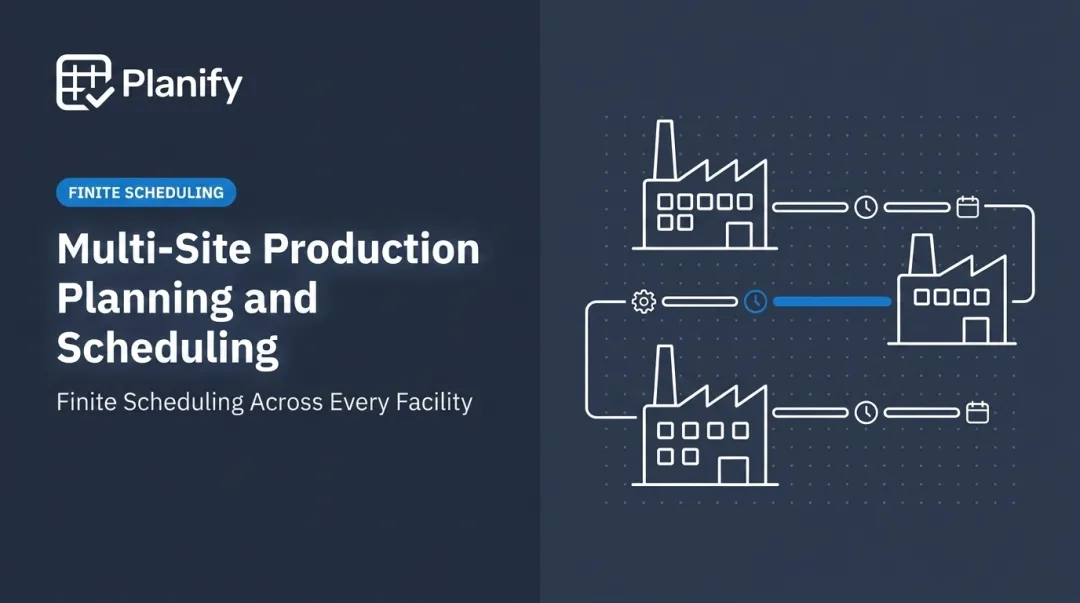
Multi-site management is the practice of coordinating operations across multiple physical locations from a centralized framework, while still letting each site run according to its own local realities.
In manufacturing, this goes well beyond IT systems or corporate reporting. It means coordinating:
- Production schedules across plants
- Inventory and material flow between facilities
- Workforce availability and shift patterns
- Shared or specialized equipment usage
A corporate office can set standards for quality, safety, and reporting. But the plant floor still needs room to operate around its own shift patterns, equipment quirks, and staffing realities. Good multi-site management holds both truths at once.
Multi-Site or Multisite?
Both spellings are correct, and dictionaries list them as interchangeable. That said, "multi-site" is the more common choice in formal and technical manufacturing writing.
The International Accreditation Forum's IAF MD 1:2023 standard formally uses "multi-site organization" in its own definitions, which gives the hyphenated form a slight edge in industry contexts. There's no strict rule here, so pick one and stay consistent.
Why Manufacturers Adopt a Multi-Site Strategy
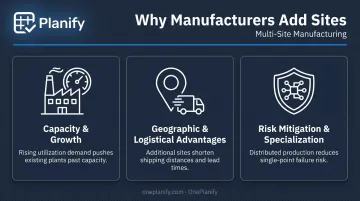
Adding a second, third, or fourth plant is rarely a vanity move. It's usually a response to one of three pressures.
Capacity and Growth
Sometimes one facility simply can't produce enough. Rather than gut-renovate an existing plant, manufacturers add capacity elsewhere.
This trend has real momentum: U.S. manufacturing capacity grew 1.1% in the year ending June 2025, according to the Federal Reserve's G.17 industrial production release. Utilization sat at 75.7%, still below the long-run average: there's room to optimize existing plants, but expansion pressure is real and growing.
Geographic and Logistical Advantages
Location matters more than most planners give it credit for. NIST's guidance for smaller manufacturers recommends mapping factory and warehouse networks around proximity to raw materials and customers specifically to minimize freight costs. Locating closer to suppliers or end markets means:
- Lower shipping costs
- Shorter lead times
- Less safety stock and raw material sitting idle
Risk Mitigation and Specialization
A single plant is a single point of failure. Equipment breaks. Storms hit. Labor markets tighten. Spreading production across multiple sites, and letting each specialize by product line or process, limits the damage any one disruption can cause.
Toyota's response to the 2011 Japan earthquake is the textbook case. The company standardized parts across producers, built up supplier inventory, and gave global regions more procurement independence.
When later earthquakes hit Japan in 2016 and 2019, Toyota's stoppages lasted two weeks or less, with no worldwide ripple effect. That's the payoff of a genuinely distributed network, but only if planners know each site's real constraints well enough to shift work there on short notice.
Core Challenges of Managing Multiple Manufacturing Sites
Adding plants multiplies opportunity. It also multiplies the ways things can go sideways.
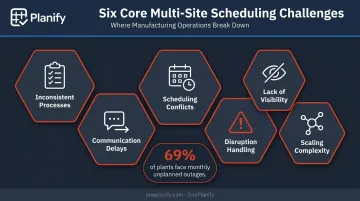
Inconsistent Processes and Standards
Each plant tends to develop its own SOPs, quality checks, and shortcuts over time. What starts as harmless local variation eventually shows up as inconsistent output between sites making the same part.
Scheduling Conflicts and Resource Allocation
Skilled labor, specialized tooling, and shared equipment don't magically distribute themselves evenly across facilities. Without real-time visibility, one plant sits idle while another falls behind.
The cost of getting this wrong is steep. ABB's 2023 survey of over 3,200 plant-maintenance decision-makers found that 69% of plants experienced unplanned outages at least monthly, with a median cost of $124,669 per hour. Multiply that exposure across a multi-site network, and scheduling blind spots get expensive fast.
Lack of Centralized Visibility
Leadership often can't answer basic questions in real time: Which plant is behind? Which is running under capacity right now? Without a shared view, decisions get made on stale information.
Communication Delays and Data Silos
Machine breakdowns, order changes, and material shortages need to travel fast between sites. When systems don't talk to each other, that information moves at the speed of a phone call or an email chain, which is to say, too slowly.
Disruption Handling
A breakdown at one site can cascade into rescheduling needs at another, especially when facilities share resources, customers, or supply chains.
The Manufacturing Leadership Council found that 70% of manufacturers still enter at least some production data manually, and only 56% collect at least half of their data in real time, according to its 2024 Data Mastery study. That gap makes fast, accurate disruption response nearly impossible.
Scaling Complexity
Two plants can be coordinated with spreadsheets and phone calls, barely. Add a third or fourth, and manual coordination stops scaling. Something has to change.
Essential Features of an Effective Multi-Site Management Approach
Not every multi-site tool is built the same way. Here's what actually matters when evaluating options.
Centralized dashboard and visibility. One view showing status, capacity, and performance across every location, not six browser tabs and a shared spreadsheet.
Standardized templates with local flexibility. Core processes stay consistent company-wide, while site managers keep control over shift patterns and equipment-specific constraints. A per-work-center schedule lets one facility run three shifts while another runs a skeleton overnight crew, without either plant fighting the system.
Real-time data sharing and integration. Systems need to connect to ERP, MES, and scheduling tools so information moves automatically instead of manually. That typically works through a few technical patterns:
- CSV file exchange
- API connections
- Direct database reads
Role-based permissions. Corporate planners need different access than site-level supervisors. A structure with distinct planner, foreman, and viewer roles keeps scheduling authority centralized while giving floor staff the visibility they need without bottlenecking every decision through one person.
Scalability. Onboarding a new plant shouldn't require a six-month IT project. SaaS-delivered, browser-based tools let a new facility come online by connecting production data, not deploying servers.
Finite scheduling capability. The one manufacturers most often overlook. Multi-site coordination means nothing if the underlying schedule assumes infinite capacity. A finite scheduling engine, like the one built into OnePlanify, accounts for real setup times, shift calendars, and job dependencies at every site simultaneously, so a schedule that looks fine on paper holds up on the floor.
Best Practices for Multi-Site Management Success
Getting multi-site operations right depends less on new software and more on getting the sequence of decisions right.
- Establish a clear governance model. Decide upfront what's standardized company-wide (safety protocols, quality benchmarks) versus what each site controls locally (shift structure, day-to-day scheduling calls).
- Use cross-site reporting to benchmark performance. Track the same KPIs at every plant. When one site consistently outperforms, figure out why and push that practice to the rest of the network.
- Invest in purpose-built tools instead of spreadsheets. Spreadsheet scheduling works for one plant, barely. Across multiple sites with shared resources and dependent operations, it breaks down fast: dropped constraints, version conflicts, and hours lost to manual recalculation every time something changes.
This is where a tool like OnePlanify fits naturally into a multi-site strategy. It's a finite scheduling platform built for the messy reality of shop floors (setups, shift changes, dependencies, and disruption) without the complexity of traditional APS software.
A few things worth knowing:
- Shift calendars are set per work center, not per facility, so one plant can run three shifts while another runs two, all under the same account and scheduling logic.
- Disruption replanning happens in seconds, not hours, preserving every setup, shift, and dependency constraint. A "Pretend mode" lets planners test a breakdown or rush order before committing to the new plan.
- Dependency enforcement means a downstream operation never starts before its predecessor finishes, even after a full replan, which matters most when shared resources or specialized equipment are in play.
- ERP connector setup happens during onboarding, not as a separate six-month IT project, with most manufacturers running a live schedule within weeks.
None of that replaces a governance model or clean cross-site reporting. But it does mean the scheduling layer, the part that most often collapses first, is built to hold up as a network grows.
Frequently Asked Questions
What is multi-site management?
Multi-site management is the practice of centrally coordinating operations across multiple locations while allowing each site flexibility over local processes. In manufacturing, this covers production schedules, inventory, workforce, and equipment across plants.
How does multi-site management work?
It combines centralized data systems, standardized core processes, and connected tools like ERP or scheduling software. These pieces link individual sites into one unified oversight framework without stripping away local control.
Is it 'multi-site' or 'multisite'?
Both spellings are accepted and used interchangeably. "Multi-site" is more common in formal or technical manufacturing contexts, partly because industry standards like IAF MD 1:2023 use the hyphenated form.
What industries commonly use multi-site management?
Manufacturing, retail chains, healthcare systems, and hospitality groups all rely on multi-site structures. Manufacturing stands out for its added complexity around production scheduling and equipment coordination.
What are the biggest challenges of managing multiple manufacturing sites?
The top three are inconsistent processes between plants, scheduling conflicts over shared resources, and a lack of real-time visibility into what's happening across the network. Communication delays and disruption handling compound all three.
How does scheduling software help with multi-site manufacturing operations?
Finite scheduling tools synchronize resources, model disruptions before they hit the floor, and give planners visibility across facilities. OnePlanify does this by preserving shift, setup, and dependency constraints even during a full replan.