
This scene plays out on shop floors every week. Capacity planning is the process of figuring out whether you have enough machine hours, labor, and materials to meet demand in a given period, and deciding what to do when you don't. Skip it, and you're guessing. Guessing leads to missed deadlines, unplanned overtime, and machines sitting idle while other work centers drown.
This guide covers the types of capacity planning, the three core strategies (lead, lag, and match), a step-by-step planning framework, and best practices built specifically for manufacturing shop floors.
Key Takeaways
- Matching machine, labor, and material capacity to demand prevents missed deadlines and broken commitments
- Three strategies add capacity: lead (ahead of demand), lag (after demand), and match (incremental, data-driven)
- A practical target is 75-85% planned utilization, leaving room for downtime and changeovers
- Capacity planning tells you if you have room; finite scheduling determines what runs when
What Is Capacity Planning?
Capacity planning determines whether a facility has enough machine hours, labor, and materials to meet demand in a given period, and what to do about the gap when it doesn't.
For manufacturers specifically, getting this wrong shows up fast on the P&L:
- Missed delivery dates when committed orders exceed real available capacity
- Unplanned overtime costs from scrambling to cover gaps discovered too late
- Idle equipment when capacity gets over-committed in one area while another work center sits empty
- Inaccurate job quoting because sales quotes lead times without knowing true floor availability
The financial stakes are real. Deloitte estimates unplanned downtime costs industrial manufacturers roughly $50 billion per year, and poor maintenance strategies alone can strip 5% to 20% of a plant's productive capacity, according to Deloitte's research on predictive maintenance.
McKinsey adds that in industries like chemicals and agriculture, unplanned maintenance runs three to five times costlier than planned maintenance, and unplanned equipment downtime is typically the single largest cause of lost production. A capacity plan that ignores realistic downtime windows is building on sand.
Types of Capacity Planning
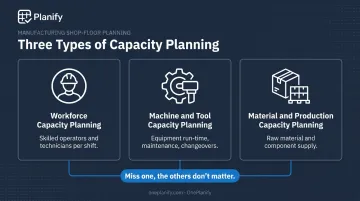
Manufacturing capacity planning breaks down into three interconnected areas. Miss any one, and the other two don't matter.
Workforce Capacity Planning
This means having the right number of skilled operators and technicians scheduled for each shift, not just warm bodies. A machine with no certified operator isn't available capacity, no matter what the schedule says.
Machine and Tool Capacity Planning
This ensures equipment and tooling have enough available run-time to meet the production schedule. It accounts for scheduled maintenance, tooling changeovers, and realistic uptime, not theoretical 24/7 availability.
Material and Production Capacity Planning
Even with machines and operators ready, output stalls if raw material or component supply can't keep pace with planned volumes. Material shortages are a capacity constraint just like a broken spindle.
Capacity Planning Strategies: Lead, Lag, and Match
Once you know your capacity picture, you need a strategy for adjusting it as demand shifts. Three common approaches show up across manufacturing operations.
Lead Strategy
A lead strategy adds capacity ahead of anticipated demand, based on sales forecasts. Think extra shifts, new hires, or new equipment brought online before the orders actually land.
Example: A plant adds a second shift ahead of a forecasted seasonal spike in orders. If the forecast is right, they're ready on day one. If demand falls short, they're carrying idle labor and equipment costs with nothing to show for it.
Lag Strategy
A lag strategy waits until demand has materialized before adding capacity. This lowers the risk of paying for capacity nobody uses, but it raises the risk of missing delivery windows while you scramble to catch up.
Example: A shop floor brings in temporary labor or subcontracts overflow work only after a new order is confirmed. No wasted spend, but also no head start.
Match Strategy
A match strategy splits the difference. Capacity scales incrementally as demand signals emerge, blending lag's lower cost risk with lead's responsiveness.
The catch: match only works with accurate, near-real-time visibility into machine and labor availability. Without it, you're incrementally scaling based on guesses, which defeats the purpose. That's why most manufacturers running a match strategy pair it with dedicated scheduling software, like OnePlanify's finite scheduling platform, rather than a static spreadsheet updated once a month.
The Capacity Planning Process: A Step-by-Step Framework
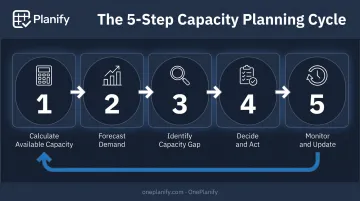
A capacity plan isn't a one-time calculation. It's a five-step cycle that repeats.
Calculate available capacity. Take (machines or workers × hours per shift × shifts per period) × a utilization target, then subtract downtime, maintenance, and changeovers. Most manufacturers target 75-85% utilization, since floor conditions rarely allow full theoretical run-time.
Forecast demand and committed work. Combine confirmed orders with probability-weighted pipeline demand. Break this down by required machine type or operator skill, not just total hours, because a total-hours view can hide a shortage of one specific capability.
Identify the capacity gap. Compare available capacity against committed plus forecasted demand. This tells you whether you have headroom or a shortfall, and where specifically it lives.
Decide and act. Options include adding a shift, outsourcing overflow work, adjusting the production schedule, or renegotiating a delivery date with the customer before it becomes a crisis.
Monitor and update continuously. A plan built on last month's data goes stale fast. Machine breakdowns, rush orders, and material delays are routine on the shop floor, so ASCM recommends a weekly or more frequent review process rather than a quarterly check-in.
Capacity Planning Best Practices for Manufacturers
A few habits separate capacity plans that hold up from ones that fall apart by week two:
- Leave a buffer for reality by planning to 75-85% utilization, not 100%. This absorbs machine downtime, changeovers, and rework without blowing up delivery commitments. For context, Federal Reserve data shows real-world utilization rarely hits triple digits.
- Track capacity by constraints—like specific skills and machine types—not just aggregate hours. A shortage of one certified welder or specialized CNC machine is a real capacity gap, even if total hours look fine.
- Create a cross-functional planning cycle that includes sales, production, and maintenance. Sales knows what's coming, production knows what's possible, and maintenance knows what's about to break. Reviewing plans weekly keeps them honest.
Capacity Planning vs. Finite Scheduling: Why Planning Alone Isn't Enough
Capacity planning and finite scheduling answer two different questions:
| Question | Capacity Planning | Finite Scheduling |
|---|---|---|
| Scope | Do we have enough capacity this month or quarter? | Which job runs on which machine, in what sequence, today? |
| Layer | Strategic | Operational |
| Accounts for | Aggregate machine, labor, and material hours | Setups, shift changes, job dependencies, real-time disruption |
Capacity planning is the strategic layer. It tells you whether there's room for a new order.
Finite scheduling is the operational layer that turns that plan into an actual, executable shop floor schedule. It accounts for setup times, shift changes, and job dependencies your capacity number alone can't capture.
Here's the problem: a capacity plan can say you have room, and the floor can still fall apart.
A changeover that eats 45 minutes between two specific jobs, a third-shift skeleton crew, a downstream operation waiting on an upstream one to finish — none of that shows up in a capacity number.
It shows up in a schedule.
This is the gap OnePlanify's scheduling platform, Planify, is built to close. Once a capacity plan confirms there's room for new work, Planify turns that plan into a day-to-day schedule the floor can actually run:
- Sequence-dependent setup times model exact changeover durations between specific job pairs, so a schedule that looks 85% utilized on paper doesn't quietly run at 60% in reality
- Shift-aware calendars per work center prevent jobs from landing on shifts that don't exist, whether that's a weekend, a holiday, or a skeleton third shift
- Predecessor locks on multi-operation routings stop any downstream operation from starting before its upstream step finishes, even after a disruption forces a full replan
When a machine breaks or a rush order lands, Planify replans the entire board in seconds, not the hours a manual spreadsheet update takes, without dropping any of those constraints.
It's built to sit alongside your existing ERP, spreadsheet-familiar enough for a planner to run on day one, but constraint-aware enough to handle what a capacity number alone never could.
Frequently Asked Questions
What are the capacity planning strategies?
The three main strategies are lead, lag, and match. Lead adds capacity ahead of forecasted demand, lag adds it after demand is confirmed, and match scales capacity incrementally as real-time demand signals emerge.
What is an example of capacity planning?
A shop compares current machine and labor capacity against a new order's requirements. If there's a shortfall, they decide whether to add a shift, approve overtime, or subcontract the overflow work.
What is the difference between capacity planning and production scheduling?
Capacity planning is strategic: it answers whether you have enough total capacity for a period. Production scheduling is tactical: it determines exactly which job runs on which machine and when.
What is a good utilization rate for a manufacturing team?
Many manufacturers target 75-85% planned utilization rather than 100%. That buffer covers downtime, changeovers, and unplanned rework without derailing delivery commitments.
How do you calculate capacity for a manufacturing plant?
A starting-point formula is: number of machines or workers × hours per shift × shifts per period × a utilization target. Adjust further for maintenance windows, changeovers, and other non-productive time specific to your floor.
What are the main types of capacity planning?
Capacity planning typically breaks into three types: workforce (staffing and skills), machine or tool (equipment run-time), and material or production (raw material and component supply).