Introduction
Supply chains haven't settled down. Nine in ten supply-chain executives ran into disruptions in 2024, and manufacturers are still short-staffed heading into a decade where 3.8 million new workers will be needed just to keep pace.
Amid that pressure, production planning still gets treated like a textbook topic: forecasts, capacity, resource coordination. But its real value shows up somewhere messier — an idle CNC machine at 2 p.m., a missed customer deadline, a stockout that stalls three downstream jobs.
This article skips the theory and focuses on what production planning actually prevents on the shop floor.
TL;DR
- Production planning determines what to make, how much, and when, aligning materials, labor, and equipment
- Effective planning drives lower cost per unit, higher machine utilization, and faster disruption recovery
- Skipping it leads to reactive firefighting and costs that compound each quarter
- The biggest value comes when plans adapt in real time, not just once at the start of a run
What Is Production Planning?
Production planning is the process of deciding what to produce, how much, and when, by matching demand forecasts against available materials, labor, and machine capacity before manufacturing begins.
The Association for Supply Chain Management describes it as an aggregate-level evaluation of supply and demand that reconciles product portfolio, demand, and financial plans while weighing trade-offs between them, according to ASCM's exam content manual.
It applies across manufacturing types, including:
- Batch production: running products in defined lots
- Discrete manufacturing: distinct, countable units like CNC parts
- Process manufacturing: continuous flow, such as chemicals
- Job-shop environments: highly customized, low-volume work
Regardless of the environment, production planning doesn't stop once the numbers are set. It defines the direction (what to build, when, and with what resources), and production scheduling turns that direction into a day-to-day, machine-by-machine timeline. Planning sets the strategy; scheduling executes it.
Key Advantages of Production Planning
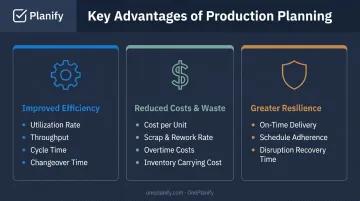
The advantages below aren't abstract. Each one maps to a metric a shop floor already tracks: on-time delivery rate, cost per unit, machine utilization, order accuracy. When planning slips, these are the numbers that move first.
Improved Efficiency and Resource Utilization
Production planning matches labor, machines, and materials to what a run actually requires, not what a schedule assumes it requires. Mapping demand against capacity before work begins avoids the last-minute scramble for overtime staff or rush-ordered stock.
The setup time problem is bigger than most schedules admit. Most ERP and spreadsheet plans ignore changeover time almost entirely, which is why a schedule that looks 85% utilized on paper often runs closer to 60% in reality once re-tooling is accounted for.
OnePlanify's Planify platform addresses this with sequencing intelligence, modeling sequence-dependent setup times between individual job pairings. A transition from Job A to Job B might take 45 minutes, while A to C takes just 15.
The system groups compatible jobs together, similar to group technology principles, so machines spend more time producing and less time being re-tooled.
The cost of getting this wrong is significant: Siemens estimates that large industrial plants lose an average of $1.4 trillion annually to unplanned downtime, or roughly 11% of revenue across the world's 500 largest companies.
KPIs impacted:
- Machine utilization rate
- Labor efficiency
- Setup/changeover time
- Throughput
This advantage matters most in facilities running multiple product lines with frequent changeovers, where every hour of hidden setup time is an hour not spent producing.
Reduced Costs and Waste
Planning aligns production volume with actual demand, which stops overproduction and excess raw material orders before they happen. Accurate forecasting paired with inventory-aware scheduling keeps stock lean without tipping into shortages.
Overproduction isn't a minor inefficiency. The American Society for Quality classifies excess inventory as one of the eight core wastes in lean manufacturing, meaning it doesn't just tie up capital but actively works against operational efficiency.
Tighter alignment between planned and actual output reduces carrying costs, scrap, and rework. Fewer emergency purchases and less scrap protect margins directly, without requiring a single new sale.
KPIs impacted:
- Inventory carrying cost
- Scrap/rework rate
- Cost per unit
- Raw material utilization
The payoff is largest when materials are expensive, perishable, or tied to long lead times, the kind of inputs where a planning miss becomes an expensive one fast.
Greater Resilience and Adaptability to Disruption
A strong production plan builds in buffer logic so the shop floor absorbs disruptions, whether machine breakdowns, late materials, or shift changes, without one delay cascading into ten.
Mapping dependencies between jobs and stations in advance lets planners see the downstream impact the moment a step slips, instead of discovering it three stations later.
Nine in ten supply-chain leaders reported disruptions in 2024, according to McKinsey's global supply chain survey. Disruption is now a standard operating condition for most manufacturers.
Comprehensive finite scheduling tools earn their keep here. OnePlanify's dependency mapping uses what it calls a predecessor lock system: no downstream operation can start before its upstream step finishes, even after a full replan.
Pair that with Pretend mode, which lets planners model a disruption's impact before committing changes. A planner can test three different responses in about three minutes, then commit the best one, with all setup times, shift calendars, and dependencies preserved automatically.
That's the difference between re-sequencing a schedule and starting over from a blank spreadsheet.
KPIs impacted:
- On-time delivery rate
- Schedule adherence
- Recovery time after disruption
- Order fill rate
Complex, multi-shift operations see the biggest gains here, since one delay can otherwise ripple through dozens of downstream jobs.
What Happens When Production Planning Is Missing or Ignored
Skip production planning and the shop floor doesn't just slow down — it becomes unpredictable. Common consequences include:
- Inconsistent output and unreliable delivery dates: customers stop trusting your promise dates because you can't consistently keep them
- Higher error and rejection rates from rushed production runs with no buffer for quality checks
- Reactive firefighting: constant expediting, unplanned overtime, and last-minute material orders that cost more than planned procurement ever would
- Rising costs over time as waste, scrap, and rush freight charges compound quarter after quarter
- Difficulty scaling or delegating, since production knowledge lives in a few experienced people's heads instead of a repeatable process
None of this shows up as a single dramatic failure. It shows up as a slow erosion: margins shrinking, deadlines slipping, and the same two or three people fielding every fire because nobody wrote the process down.
How to Get the Most Value from Production Planning
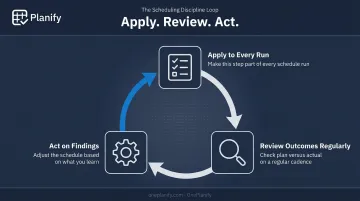
Production planning pays off when it's treated as an ongoing discipline, not a one-time document. That means:
- Apply it to every production run: not just the ones where something already went wrong
- Review outcomes on a regular cadence: check on-time rate, cost per unit, and utilization against the original plan, not just at quarter-end
- Act on what you find: adjust schedules proactively instead of leaving the plan static once it's published
That third step is where most manual processes break down. Recalculating a spreadsheet after a machine breakdown takes hours, and constraints (shift boundaries, setup sequences, job dependencies) often get dropped in the process.
Browser-based platforms like OnePlanify remove that bottleneck entirely. A full-board replan happens in seconds, with every constraint preserved, so planners can act the moment conditions shift instead of waiting until the spreadsheet catches up.
Conclusion
Production planning creates value through the control, clarity, and consistency it brings to everything that happens after the plan is made. Efficiency and cost gains compound with each cycle the plan gets refined instead of shelved — the same discipline that lets disruptions get replanned rather than derail the schedule.
OnePlanify's finite scheduling platform keeps that refinement practical. Keep the plan alive, and it keeps paying off.
Frequently Asked Questions
What is production planning?
Production planning is the process of deciding what, when, and how much to produce by coordinating demand forecasts, materials, labor, and equipment. It sets the resource strategy that scheduling later executes in detail.
What are the 5 types of production planning?
The most commonly referenced types are batch, flow/continuous, process, mass, and job/project-based production. Each is distinguished by volume, customization level, and how repetitive the production sequence is.
What are the 5 P's of production planning?
Some frameworks reference Product, Plant, Programme, Process, and People (or Programme Control) as structuring elements. These aren't a universal industry standard, so definitions vary by source and organization.
What is the difference between production planning and production scheduling?
Planning sets the overall strategy — what to produce and what resources are needed. Scheduling assigns specific machines, workers, and time slots to execute that plan on the shop floor.
What are the main steps in the production planning process?
The core steps are demand forecasting, capacity assessment, budgeting, scheduling, and ongoing monitoring and adjustment. The Association for Supply Chain Management (ASCM) frames this similarly, moving from strategic planning to demand planning, master scheduling, and execution control.
Who is responsible for production planning in a company?
A production planner or production manager typically owns this process. They work closely with sales, procurement, and shop floor supervisors to keep the plan aligned with actual demand and capacity.