Introduction
A single late shipment can throw off a week's worth of orders. A machine breaks down mid-run, and suddenly three other jobs are stuck waiting. A rush order comes in, and the whole schedule needs to be rebuilt by hand.
This is the daily reality on most shop floors, and it's exactly what production management exists to control.
Many manufacturers still lean on spreadsheets, whiteboards, or disconnected systems to plan what gets made, when, and by whom. That approach works fine until volume grows, disruptions hit, or a customer needs something faster than planned. Then the cracks show: missed deadlines, wasted labor, and machines sitting idle while other stations get overloaded.
This guide breaks down:
- What production management actually means
- The five resources (the "5 M's") every production manager balances
- The different levels and types of production systems
- The tools, including modern scheduling software, that make it work in practice
Key Takeaways
- Production management plans, organizes, directs, and controls materials, labor, and capital into finished goods efficiently.
- It spans three planning horizons: strategic, tactical, and operational.
- Four production system types exist: job, batch, mass, and continuous.
- The 5 M's (Men, Machines, Methods, Money, Materials) form every production strategy's resource base.
- Software increasingly handles operational tasks, especially finite scheduling on the shop floor.
What Is Production Management?
Production management is the governance of the resources that turn raw materials into finished products: labor, equipment, capital, and materials. It covers four core activities:
- Planning what to make and when
- Organizing the people and machines to make it
- Directing day-to-day execution on the floor
- Controlling output against the original plan
Put simply, it's the discipline that keeps a factory's output matching what customers were promised, on time.
Production Management vs. Operations Management
These two terms get used interchangeably, but there's a meaningful distinction. Production management deals specifically with manufacturing physical goods. Operations management is the broader umbrella term, covering both goods production and service delivery: think hospitals, airlines, and consulting firms alongside factories.
If your business makes something tangible on a shop floor, production management is the more precise term for what you're doing every day.
That precision matters beyond semantics. Production management carries real weight in the labor market: industrial production managers in the US earned a median salary of $121,440 per year in 2024, according to the Bureau of Labor Statistics.
The BLS also projects roughly 17,100 job openings annually through 2034, even with modest overall employment growth. That steady pipeline of openings signals lasting demand for production management skills across manufacturing.
The 5 M's of Production Management
Every production manager, whether they run a five-person job shop or a 500-person plant, is balancing the same five resources. This framework (the 5 M's) has anchored production management thinking for decades:
- Men (people): The workforce operating machines, running processes, and making judgment calls on the floor
- Machines: Equipment, tooling, and technology used to convert materials into product
- Methods: The procedures, sequences, and strategies that govern how work gets done
- Money: Capital allocated for equipment, labor, materials, and overhead
- Materials: Raw inputs, components, and information that flow through the production process
Coordinating these five elements well is what separates a well-run operation from one that's constantly firefighting.
Some newer frameworks add a sixth "M" for Markets, arguing production must align with customer demand, not just internal efficiency. It's a useful addition, though not yet part of the traditional model.
Types of Production Management
Production management gets categorized two ways: by how far out you're planning (the time horizon) and by what kind of production system you're running. Both matter, and they interact constantly — a strategic decision about plant capacity eventually becomes a tactical staffing plan, which then becomes an operational schedule for next Tuesday.
The Three Levels of Production Management
| Level | Time Horizon | Typical Decisions |
|---|---|---|
| Strategic | 5–10 years | New products, plant locations, market entry |
| Tactical | 1–2 years (varies by industry) | Capacity building, technology selection, inventory policy |
| Operational | Days to a couple of weeks | Order sequencing, scheduling, day-to-day execution |
Strategic production management sets the long-term direction: where to build a plant, which products to launch, how to structure the supply network. Tactical production management translates that direction into mid-range plans, such as adding a shift or investing in new equipment.
Operational production management is where the rubber meets the road. This is scheduling, sequencing, and monitoring active jobs, day by day and hour by hour.
It's also the level most manufacturers still manage manually, in spreadsheets or on whiteboards, and where the biggest efficiency gains tend to hide. Purpose-built finite scheduling software, like OnePlanify, is designed specifically for this layer.
The Four Types of Production Systems
Most manufacturing falls into one of four production system types:
- Job production – Custom, one-off items built to a specific customer's spec, like a prototype aircraft component or a custom fabrication project
- Batch production – Goods made in limited groups before switching to a different product, common in specialty chemicals or machine tool shops
- Mass production – High-volume, standardized output on assembly lines, the model most associated with automotive manufacturing
- Continuous production – Uninterrupted, round-the-clock runs typical of process industries like chemicals or food processing
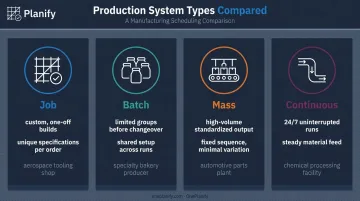
Each system type demands a different scheduling approach. A job shop juggling dozens of custom orders has a fundamentally different planning problem than a plant running one product 24/7.
Key Functions of Production Management
Regardless of the production system in use, production managers are responsible for five core functions:
- Production planning – Forecasting demand, planning inventory needs, and deciding what to produce, when, and with which resources
- Production control – Monitoring active runs against the plan and adjusting for quality, cost, or timing deviations as they surface
- Quality management – Running quality assurance and quality control checkpoints so output consistently meets spec
- Inventory management – Balancing raw materials, work-in-progress, and finished goods so nothing sits idle or runs short
- Process improvement – Continuously identifying inefficiencies in workflow, technology, or resource use to reduce waste
These functions aren't sequential steps you complete once. They run in parallel, all day, every day a plant is operating.
A production manager who's great at planning but weak on control ends up with beautiful plans that never survive contact with the actual shop floor.
Techniques and Tools Used in Production Management
Several established methodologies underpin most production management strategies:
- Lean manufacturing – Removes non-value-added activity and improves process flow, per NIST's Manufacturing Extension Partnership
- Just-in-Time (JIT) – Minimizes inventory buffers, relying on tight supplier coordination and controlled processes
- Total Quality Management (TQM) – A customer-focused system engaging every employee in continual, fact-based improvement
- Material Requirements Planning (MRP) – Time-phases material needs using bills of material and lead-time data, telling planners when to release orders
ERP and MES systems help centralize this data across planning, inventory, and shop-floor operations. But here's the gap: most ERP scheduling modules assume infinite capacity.
They don't know that Machine 3 already has a six-hour setup queued, or that half the crew is out for a holiday. That's exactly why so many manufacturers still fall back on spreadsheets for the final, granular scheduling step — even after investing heavily in an ERP.
Where Finite Scheduling Software Fits
This is the specific gap finite scheduling software fills. Tools like OnePlanify sit at the operational layer, sequencing orders around real machine capacity rather than theoretical capacity.
In practice, this means the software accounts for details that spreadsheets and basic ERP modules typically miss:
- Sequence-dependent setup times – recognizing that switching from Job A to Job B might take 45 minutes, while Job A to Job C takes 15
- Real shift calendars – enforcing 1st, 2nd, and 3rd shift patterns, weekend closures, and holiday exceptions at the work-center level
- Multi-operation routing – locking downstream operations (like welding) so they can't start before an upstream operation (like milling) finishes
OnePlanify connects to existing ERP systems, such as Epicor, SYSPRO, JobBOSS, or NetSuite, via CSV, API, or direct database access. It pulls work orders, routings, and work-center data without requiring a separate IT project.
It's built specifically to fit alongside an ERP, not replace one. That keeps onboarding measured in weeks rather than the six-to-twelve-month timelines common with full APS deployments.
Why Production Management Matters for Manufacturers
Poor production management is expensive, and the numbers back that up. A NIST-published study estimated $119.1 billion in preventable losses across US manufacturers, including $18.1 billion tied directly to downtime, though NIST notes wide uncertainty in that figure given survey sample size (NIST, 2020). Even accounting for that uncertainty, the direction is clear: inefficient scheduling and planning carry a real cost.
Effective production management also drives on-time delivery. Consider Hope's Windows, a manufacturer whose lead times had stretched past 19 weeks as sales grew. After a value-stream improvement project supported by NIST's Manufacturing Extension Partnership, on-time delivery jumped from 30% to more than 70%.
Improving on-time delivery requires a plan that survives contact with the shop floor. The hardest part of production management happens after that plan gets disrupted: rush orders arrive, machines break down mid-run, and shifts get short-staffed. This is the "messy" reality that makes or breaks a schedule's usefulness.
It's also the specific problem OnePlanify was built to solve. When a machine goes down, the platform replans the entire schedule board in seconds, preserving setup, shift, and routing constraints throughout.
Its "Pretend Mode" lets planners test a disruption's impact before committing, so decisions get made with real visibility instead of guesswork. That's the difference between a schedule that looks good on paper and one the floor actually runs on.
Frequently Asked Questions
What is production management?
Production management is the planning, coordination, and control of inputs like labor, materials, and capital to produce finished goods efficiently. It spans everything from long-term capacity decisions down to daily order scheduling.
What are the 5 M's of production management?
The 5 M's are Men, Machines, Methods, Money, and Materials — the core resources every production manager coordinates. Together they cover people, equipment, processes, capital, and physical inputs.
What are the four types of production management?
The four common production system types are job, batch, mass, and continuous production. Each fits a different combination of order volume, product variety, and equipment setup.
What is the difference between production management and operations management?
Production management focuses specifically on manufacturing physical goods. Operations management is broader, covering both goods production and service delivery across industries like healthcare and logistics.
What are the main functions of production management?
The main functions are planning, control, quality management, inventory management, and process improvement. These run continuously and in parallel, not as one-time steps.
Why is production management important for manufacturing businesses?
Strong production management reduces costs, improves quality and delivery timelines, and helps manufacturers respond quickly to demand changes. Weak production management, by contrast, shows up directly in missed deadlines and preventable losses.